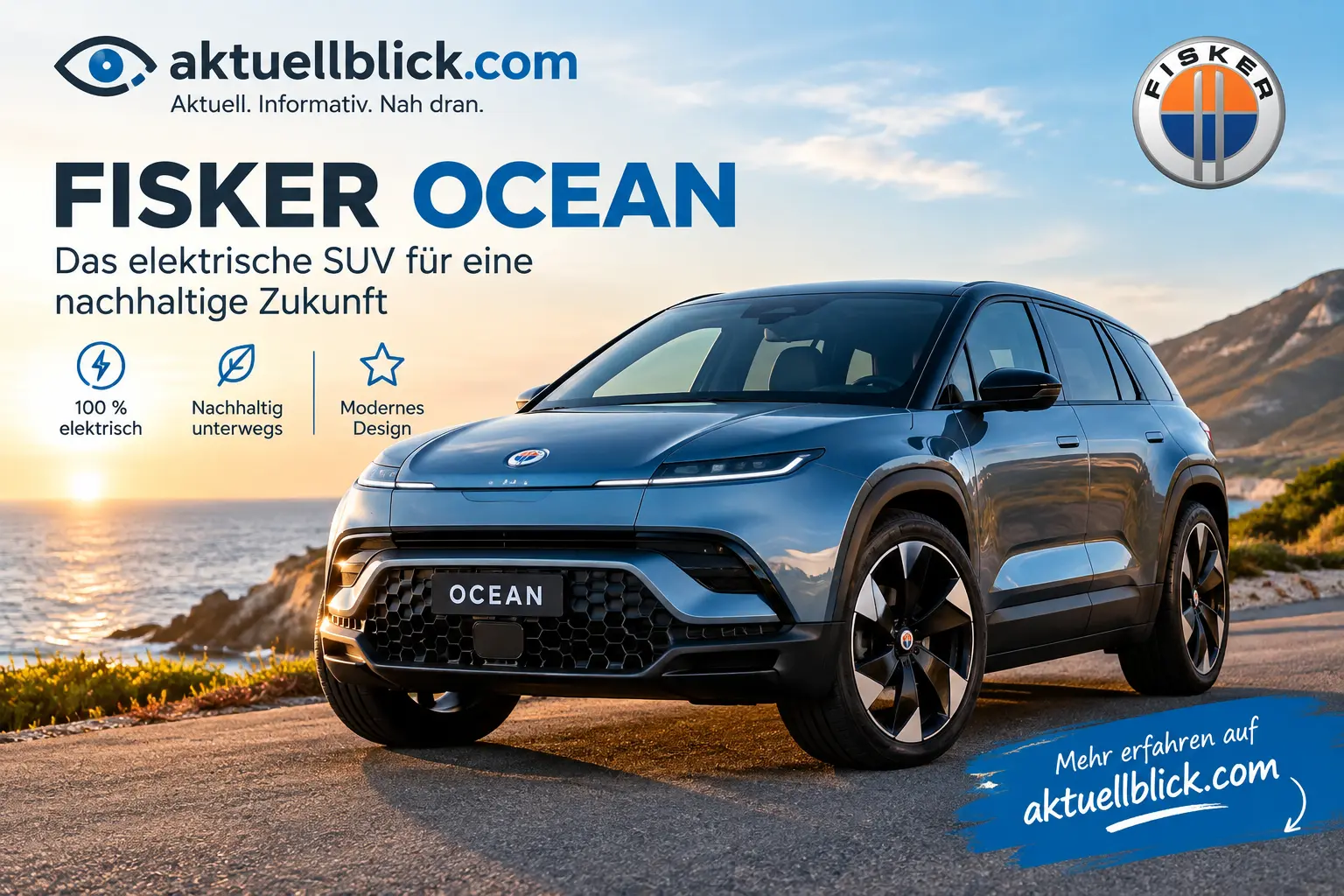

The Fisker Ocean is a fully electric midsize SUV that attracted attention for its long driving range, distinctive design, large touchscreen, solar roof, spacious cabin, and strong performance. It was developed by Fisker Inc. and manufactured through Magna Steyr in Austria. Customer deliveries began in 2023, but production ended in 2024 as the company entered financial difficulties and later bankruptcy proceedings.
In 2026, understanding the Fisker Ocean requires looking beyond its original launch specifications. Buyers and owners now have different questions: What happens if the vehicle needs a repair? Are parts still available? What software can be installed? Which recalls need attention? Is a used example worth considering? And how does ownership work without a conventional dealer network?
This guide covers those questions from A to Z, including specifications, range, battery technology, charging, trim levels, technology, common problems, recalls, software, service, parts, warranty considerations, used pricing, and ownership in 2026.
Fisker Ocean Overview
The vehicle is a five-door electric crossover SUV designed by Henrik Fisker. It was positioned as a technology-focused alternative to established electric SUVs, with an emphasis on range, sustainability, interior space, and software-driven features.
Production took place at Magna Steyr’s facility in Graz, Austria. The first customer delivery occurred in Europe in May 2023, followed by U.S. deliveries in June 2023. Production ultimately stopped in March 2024. Current reference data puts total production at roughly 11,000 vehicles, although figures can vary depending on whether produced, delivered, or sold vehicles are being counted.
The vehicle was offered in four main versions:
- Sport
- Ultra
- Extreme
- One
The Sport used a single-motor front-wheel-drive setup, while the higher versions used dual motors and all-wheel drive.
The most important difference in 2026 is that this is no longer a conventional new-car ownership proposition. The vehicle itself remains a capable EV, but the manufacturer-support environment is very different from what buyers would expect from a current-production model.
Fisker Ocean Specs and Key Features
The specifications vary considerably by trim, so quoting one number for every version can be misleading.
The Sport uses a smaller lithium iron phosphate battery and front-wheel drive. The Ultra, Extreme and One use a larger nickel-manganese-cobalt battery and dual-motor all-wheel drive.
According to Fisker’s product documentation, European-market WLTP figures were approximately:
| Trim | Drive | Battery | Claimed WLTP Range |
|---|---|---|---|
| Sport | FWD | 73 kWh LFP | 288 miles / 464 km |
| Ultra | AWD | 113 kWh NMC | 429 miles / 690 km |
| Extreme | AWD | 113 kWh NMC | 439 miles / 707 km |
| One | AWD | 113 kWh NMC | Around 439 miles / 707 km |
Actual range depends on temperature, speed, wheels, terrain, climate control, battery condition and driving style. Fisker’s own documentation also notes that its WLTP figures are calculated under specific test conditions.
The vehicle’s main features include:
- Fully electric powertrain
- Large central touchscreen
- Digital instrument display
- Driver-assistance technology
- SolarSky roof on applicable versions
- California Mode
- Power tailgate
- Over-the-air software capability
- Regenerative braking
- Heat pump on higher trims
- AWD on Ultra, Extreme and One
- Large cargo area
- Multiple drive modes
The combination of long claimed range and relatively high equipment levels was one of the vehicle’s biggest selling points.
Fisker Ocean Range and Battery
Battery size is one of the most important differences between versions.
The Sport uses an approximately 73 kWh usable-class battery based on LFP chemistry, while the larger versions use a 113 kWh-class NMC battery pack. Different technical sources may quote total capacity, usable capacity, or rounded figures, so these numbers should not be treated as interchangeable.
The large battery was designed to give the Ultra, Extreme and One unusually high official range for their class. The Extreme was marketed with up to about 439 miles of WLTP range in European testing. The Sport was rated at about 288 miles WLTP.
What affects real-world range?
A vehicle rarely achieves its laboratory figure in every situation.
Important factors include:
- Highway speed
- Outside temperature
- Heating and air conditioning
- Wheel and tire configuration
- Wind
- Elevation changes
- Payload
- Battery temperature
- Driving style
- Battery health
Cold weather can reduce EV efficiency because energy is required to heat the cabin and battery. High-speed motorway driving can also reduce range substantially compared with controlled test conditions.
For a used vehicle in 2026, battery condition matters just as much as the original specification.
Charging Time and Charging Options
Charging depends on the vehicle version, market and charging equipment.
Owners can charge using home AC charging, public AC charging or DC fast charging. North American vehicles use the charging standards appropriate to that market, while European versions use Type 2/CCS2 hardware.
The product guide lists approximately 31 minutes for a Sport to charge from 10% to 80% on a suitable DC fast charger, while the larger-battery versions are listed at approximately 34 minutes under the specified conditions. Level 2 charging takes substantially longer, with the large battery requiring roughly 12 hours for a full charge under the listed conditions.
How does DC fast charging work?
A DC fast charger sends direct current to the vehicle’s high-voltage battery at much higher power than normal household AC charging.
Charging speed is not constant. The vehicle normally accepts more power at lower battery percentages and reduces power as the battery approaches a high state of charge. This is why a 10–80% charging estimate is more useful than simply asking how long a completely empty battery takes to reach 100%.
For everyday ownership, charging overnight at home is generally more predictable than depending entirely on public fast chargers.
Fisker Ocean Performance
Performance varies dramatically between trims.
The Sport is designed more around efficiency and practicality, using front-wheel drive and a single motor. The Ultra and Extreme use dual motors and all-wheel drive, giving them considerably stronger acceleration.
Fisker’s product documentation lists approximately 282 hp for the Sport and up to 564 hp for the Ultra and Extreme configurations, with 0–100 km/h acceleration of around 7.9 seconds for the Sport and 4.2 seconds for the Ultra and Extreme under the specified testing conditions.
Some sources quote slightly different power figures because manufacturers may use peak, continuous, software-limited or market-specific measurements.
This matters when comparing specifications: always check whether the number refers to horsepower, metric horsepower, kilowatts or a particular software mode.
Fisker Ocean Trim Levels
The range was structured around four major trim names.
Sport was the entry version and focused on efficiency and a lower purchase price.
Ultra added dual-motor AWD, the larger battery and substantially stronger performance.
Extreme represented the higher-performance, high-equipment version and was marketed around maximum range and additional technology.
One was the launch-edition model and shared much of its technical foundation with the higher-performance versions.
When shopping for a used vehicle, trim level should be confirmed through the VIN and vehicle equipment rather than relying only on a seller’s advertisement.
Fisker Ocean Sport, Ultra, Extreme and One
The Sport is particularly different because it uses a smaller battery, LFP chemistry and front-wheel drive.
The Ultra moves to the large battery and dual-motor AWD configuration.
The Extreme adds additional equipment and was designed to deliver the longest official range in the lineup.
The One was a launch-edition vehicle with a high equipment level and dual-motor architecture.
One important 2026 buying point is that trim does not automatically tell you the current condition of the vehicle. A lower-mileage Extreme with unresolved recall or software issues may require more attention than a higher-mileage vehicle with documented maintenance and updates.
Fisker Ocean Interior and Technology
The cabin was designed to feel different from many traditional SUVs.
One of its most noticeable features is the large central touchscreen. Depending on software and configuration, the screen can change orientation for different use cases.
The vehicle also introduced features intended to create a more flexible passenger environment.
California Mode
California Mode opens multiple windows and the roof area together to create an open-air driving experience.
Hollywood Mode
Hollywood Mode is designed around rear-seat entertainment and screen use, turning the cabin into a more lounge-like environment.
SolarSky Roof
Higher trims could be equipped with SolarSky, a photovoltaic roof designed to generate electricity from sunlight.
The amount of energy generated varies significantly according to weather, season, parking conditions, roof exposure and other factors. It should therefore be viewed as an efficiency feature rather than a replacement for normal charging.
Fisker Ocean Dimensions and Cargo Space
The vehicle sits in the midsize electric SUV category and was designed to provide substantial passenger and cargo room.
Published specifications list approximately 476 liters of cargo capacity behind the second row and around 918 liters with the rear seats folded, although measurement methods can differ between markets and sources.
For everyday use, the important advantages are the relatively practical rear seating area and flexible cargo space.
Families should also consider child-seat placement, rear-seat access, charging equipment storage and the space required for luggage rather than looking only at the headline cargo number.
Driving Experience and Handling
The driving character depends heavily on the trim.
The Sport’s front-wheel-drive configuration makes it the simpler version mechanically.
The dual-motor versions provide substantially more traction and acceleration. AWD can be particularly useful when roads are wet or slippery, although all-wheel drive does not eliminate the need for suitable tires and careful driving.
Regenerative braking can return some kinetic energy to the battery during deceleration. How strong the effect feels depends on the vehicle’s software settings and driving mode.
The low-mounted battery also helps lower the center of gravity compared with many conventional gasoline SUVs.
Fisker Ocean Problems and Common Issues
The most important ownership difference in 2026 is that problems cannot be evaluated only as ordinary reliability issues.
A small software fault can become more significant when a manufacturer no longer operates a normal global dealer network.
Reported ownership concerns have included:
- Software bugs
- Infotainment problems
- Door-handle issues
- Key and locking problems
- 12-volt battery issues
- Charging-related faults
- Warning messages
- Communication faults between vehicle systems
- Parts availability
- Difficulty finding qualified service providers
Not every vehicle experiences these problems, and a reported issue does not mean that every unit is defective.
The condition of an individual vehicle, its software version, recall history and previous repairs are therefore critical.
Software and Infotainment Issues
Software is one of the most important parts of the ownership story.
The Ocean relies on multiple electronic control systems, and software versions do not all refer to the same component. Owners may encounter references to FiskerOS, VCU, PDU, ADAS and later software releases.
Some problems that look like mechanical faults can actually involve software communication or calibration.
Older recall documentation shows that software updates were used to address issues affecting vehicle systems. One 2024 technical bulletin, for example, covered a VCU and MCU software update for 2023 vehicles after issues associated with loss of motive power.
In 2026, buyers should therefore ask:
- Which software version is installed?
- Have recall-related software updates been completed?
- Does the vehicle have the latest supported update available for its region?
- Are all screens and cameras functioning?
- Does the vehicle communicate correctly with its mobile or connected services?
The answer to these questions can be more valuable than simply knowing the odometer reading.
Battery, Charging and 12V Problems
The high-voltage battery and the smaller 12-volt electrical system serve different purposes.
The traction battery powers the vehicle’s electric drivetrain. The 12-volt battery powers many conventional electrical systems and control electronics.
A weak 12-volt battery can produce confusing symptoms, including warning messages, locking problems, startup issues or apparently unrelated electronic faults.
Charging problems can also have several causes:
- Faulty charging equipment
- Cable problems
- Communication errors
- Software faults
- Temperature
- Battery state of charge
- Electrical supply limitations
A buyer should test both AC and DC charging where possible instead of assuming that the presence of a charging cable means the charging system is healthy.
Fisker Ocean Recalls and Safety Issues
Several safety and compliance campaigns affected Ocean vehicles.
One important recall involved the electric water pump. NHTSA recall 24V-499 covered 2023–2024 Ocean vehicles and described a communication failure involving the cabin electric water pump that could cause the high-voltage battery management system to enter limp mode and result in loss of drive power. The recall involved thousands of vehicles.
Another campaign addressed vehicle-control software. NHTSA documentation shows a software update affecting 2023 Oceans because of incorrect fault-monitor calibration associated with dynamic safe states and loss of motive power.
There was also a U.S. compliance recall involving instrument-cluster warning telltales. The remedy involved software version 2.1 delivered over the air.
A further recall report filed in 2025 involved certain 2023–2024 vehicles and concerns around shifting into Park or the intended gear, with the report describing a potential unexpected vehicle movement risk.
These campaigns demonstrate why recall status should be checked by VIN rather than by simply searching the model name.
How to Check Fisker Ocean Recalls
The safest approach is to use the vehicle identification number, commonly called the VIN.
The VIN is normally found on the vehicle and its documentation. Entering it into the relevant national recall database can show campaigns associated with that specific vehicle.
For a used purchase, ask the seller for:
- VIN
- Recall completion records
- Service invoices
- Software-update history
- Battery-related service records
- Charging-system repair records
Do not assume that because a vehicle has received one software update, every recall has been completed.
The original Fisker support information also stated that recall repair and reimbursement arrangements for 2023 vehicles were open through June 30, 2026. Because that deadline has passed, owners should verify the current process rather than assuming the old arrangement remains active.
What Happened to Fisker?
Fisker Inc. struggled with production, cash flow, deliveries, recalls, software problems and other operational challenges.
The Ocean was launched during a period when competition in the electric SUV market was becoming increasingly intense. Fisker had ambitious plans for production and global sales, but the company could not sustain its business model.
The company ultimately entered bankruptcy proceedings in 2024.
This is the key reason the ownership experience changed so dramatically. The vehicle did not simply disappear when the company failed; thousands of cars remained on roads, creating a continuing need for parts, software, repairs and technical knowledge.
Fisker Bankruptcy and Ocean Production
Ocean production ended in March 2024.
The bankruptcy changed the normal manufacturer-to-dealer-to-owner relationship. Instead of having a conventional network of active dealerships and factory service centers, owners increasingly had to depend on independent workshops, community resources, parts suppliers and specialist technicians.
Some vehicles were also transferred into fleet use. Published vehicle data reports that a large batch of remaining Oceans was sold to American Lease, with vehicles subsequently used in New York-area rideshare and taxi operations.
For a 2026 buyer, this history matters because the purchase decision is not only about the car. It is also about whether the buyer is comfortable managing a vehicle from a discontinued manufacturer.
Fisker Ocean Software Updates
Software remains one of the most important ownership considerations.
Fisker used over-the-air updates during the vehicle’s production life, and later owner-led support efforts have focused heavily on keeping vehicles functional.
Current owner-community resources in 2026 distinguish between different software components and versions, including FiskerOS, Marlin, VCU, PDU and ADAS.
The term Marlin is particularly relevant in 2026 because it refers to newer software work intended to improve the usability and functionality of existing Oceans.
Owners should not assume that the newest-looking version number automatically means every vehicle component is updated. Software systems can have separate version numbers.
Before purchasing, check the actual software state of the vehicle and whether required updates can still be obtained in the buyer’s region.
Fisker Ocean Service and Repair Support
The biggest difference from a normal modern EV is the absence of a conventional factory dealer network.
In 2026, service may involve independent workshops familiar with the vehicle, specialist technicians, owner-community resources and third-party tools.
Current owner resources describe a growing network of independent workshops and explain how owners can work with local garages to get them onto the relevant service tools.
This creates a practical question:
What happens if your local mechanic has never worked on one?
The answer depends on the problem. Basic mechanical work may be manageable for an experienced EV workshop, while vehicle-specific electronic diagnostics, software and proprietary procedures can require specialist knowledge.
Before buying one, identify a workshop within reasonable driving distance that is willing to work on the vehicle.
Fisker Ocean Parts Availability in 2026
Parts availability is much better described as limited but active rather than simply “available” or “unavailable.”
Current 2026 owner information reports that suppliers are providing parts in North America and Europe, while some components remain more difficult to obtain.
Common wear items and certain mechanical components may be easier to source than vehicle-specific electronic parts.
Parts can come from several channels:
- Existing inventory
- Specialist suppliers
- Salvaged vehicles
- Independent suppliers
- Owner networks
- Third-party manufacturers
The availability of a particular component can therefore change over time.
A buyer should be especially cautious about assuming that a rare electronic module, body component or unique interior part will be immediately available.
For the latest updates and insights, explore Can Dogs Eat Watermelon today.
Fisker Ocean Warranty After Bankruptcy
Warranty coverage is a complicated issue because the original manufacturer entered bankruptcy.
A buyer should never assume that the original factory warranty works exactly like the warranty on a currently produced vehicle.
Different elements can have different terms, and certain third-party sellers may advertise their own warranty arrangements.
Before purchasing, ask for written documentation covering:
- Vehicle warranty
- Battery warranty
- Powertrain coverage
- Remaining coverage period
- Transferability
- Who is responsible for a claim
- Where warranty repairs would be performed
A verbal promise from a private seller is not the same as documented coverage.
Fisker Ocean Reliability in 2026
Reliability should be separated into two questions.
The first is:
How reliable is the vehicle’s hardware?
The second is:
How easy is it to get the vehicle repaired when something goes wrong?
The second question is especially important in 2026.
An EV can have a fundamentally capable battery, motor and chassis while still being difficult to own if a specialized electronic component fails and few workshops can diagnose it.
That is why a pre-purchase inspection should include more than brakes, tires and bodywork.
The inspection should also cover:
- Software version
- Charging operation
- 12-volt system
- Warning messages
- High-voltage system status
- Door operation
- Cameras
- Sensors
- Touchscreen
- Climate control
- Key fobs
- Recall status
Fisker Ocean Maintenance Costs
Electric vehicles generally have fewer conventional powertrain maintenance requirements than gasoline vehicles because they do not use engine oil, spark plugs or many traditional engine components.
However, that does not mean maintenance is free.
Owners still need to consider:
- Tires
- Brake components
- Brake fluid
- Cabin filters
- Wiper blades
- Suspension components
- Cooling systems
- 12-volt battery
- Charging equipment
- Software diagnostics
- Body and interior repairs
The unusual part of ownership is that the cost of a repair can be influenced heavily by parts availability and technician familiarity.
A simple repair can be inexpensive when the component is readily available. A specialized repair can become much more expensive if the part is scarce or must be sourced internationally.
Fisker Ocean Ownership in 2026
Ownership in 2026 is different from ownership when the vehicle was new.
The car can still provide:
- Long electric range
- Strong acceleration in AWD versions
- A distinctive design
- Spacious interior
- Advanced technology
- Quiet electric driving
- Useful cargo space
But owners also need to accept:
- Limited traditional manufacturer support
- More reliance on independent service
- Potential parts delays
- Software-management challenges
- More research before repairs
- Greater importance of community knowledge
Current owner resources show that a substantial support ecosystem has developed around the vehicle, including parts, repair information, software guidance and used-buying resources.
That does not make ownership identical to owning a current Tesla, Hyundai, Kia or Ford EV. It simply means the Ocean has not become unsupported in the literal sense that every vehicle is impossible to maintain.
Fisker Ocean Used Price and Resale Value
Used pricing in 2026 varies dramatically according to condition, mileage, trim, title status, location and software/recall history.
Do not use a single internet asking price as proof of market value.
There is a significant difference between:
- Dealer asking price
- Private-party asking price
- Completed transaction
- Auction sale
- Salvage auction result
- Vehicle with a clean title
- Vehicle with unresolved damage
Auction data illustrates how widely prices can vary. Current records include substantially lower prices for damaged or salvage vehicles, which should not be compared directly with a roadworthy clean-title Ocean.
For a normal used example, condition and supportability can be more important than simply finding the cheapest listing.
Buying a Used Fisker Ocean in 2026
Buying one in 2026 requires a different checklist from buying a conventional used SUV.
First, verify the VIN.
Then check:
- Recall history
- Software version
- Charging operation
- Battery condition
- 12-volt battery condition
- Door handles
- Windows and locks
- Cameras and sensors
- Touchscreen
- Climate control
- Key fobs
- Tires
- Suspension
- Service records
- Previous accident history
- Title status
- Availability of local repair support
If possible, perform both an AC charging test and a DC fast-charging test.
A test drive should also include different speeds and road conditions so that warning messages, vibration, braking behavior and drivetrain operation can be observed.
What to Check Before Buying a Fisker Ocean
A cheap purchase price can become expensive if the vehicle needs multiple repairs.
Check the VIN
Use the VIN to investigate recalls, vehicle history and ownership documentation.
Check the software
Look through the vehicle’s settings and verify the installed software. Ask what updates have been completed.
Test every door
Door handles and locking mechanisms should be tested repeatedly rather than just once.
Test charging
Confirm that the car can charge from the equipment you intend to use.
Check the 12-volt system
Look for warning messages, unusual electrical behavior or difficulty waking the vehicle.
Inspect the battery information
A professional EV inspection can provide more useful information about battery condition than a simple dashboard range estimate.
Test the touchscreen
Make sure important functions respond correctly.
Check cameras and driver assistance
Test the cameras, sensors and available assistance systems.
Inspect tires and suspension
A heavy EV places significant demands on tires and suspension components.
Confirm service availability
Find a workshop before buying rather than waiting until the first problem appears.
Calculate the total ownership cost
Purchase price alone does not tell you whether a used EV is financially sensible.
Fisker Ocean vs Other Electric SUVs
The vehicle is often compared with models such as the Tesla Model Y, Hyundai Ioniq 5 and Kia EV6.
The comparison should not be limited to range.
| Factor | Fisker Ocean | Other established EV SUVs |
|---|---|---|
| Range | Strong official figures on higher trims | Varies by model |
| Performance | Very strong in AWD versions | Varies significantly |
| Design | Distinctive | Depends on model |
| Software | Important ownership consideration | Usually supported by active manufacturer networks |
| Parts | More specialized | Generally broader manufacturer supply |
| Service | Independent/community support is important | Established dealer/service networks |
| Used pricing | Can be unusually low | More predictable depending on model |
| Ownership risk | Higher support uncertainty | Generally easier to plan for |
The key distinction is not necessarily which vehicle has the biggest battery or quickest acceleration.
It is how much support the owner expects after purchase.
Someone comparing used electric SUVs should therefore include service availability, parts access, software support and warranty arrangements alongside range and performance.
Fisker Ocean Pros and Cons
Potential advantages
- Long official range on higher trims
- Strong AWD performance
- Distinctive exterior design
- Spacious interior
- Large central display
- Innovative cabin features
- Solar roof availability on selected versions
- Competitive used pricing in some markets
- Large battery on Ultra, Extreme and One
Potential disadvantages
- Manufacturer bankruptcy changed support arrangements
- No normal global dealer network
- Software can be an important ownership factor
- Some parts can be difficult to source
- Recall history requires careful checking
- Warranty questions require additional verification
- Independent service may be necessary
- Used condition varies considerably
- Future support can depend on third-party and owner-led resources
These factors do not mean every vehicle will experience the same problems. They explain why the ownership decision requires more research than a normal used-car purchase.
Fisker Ocean: Is It Still Worth Buying in 2026?
There is no single answer that applies to every buyer.
The vehicle can make sense for someone who understands its support situation, has access to a capable workshop, verifies the car carefully and is comfortable with the additional ownership responsibility.
It can be a very different proposition for someone who wants a completely conventional ownership experience with a large dealer network, predictable factory support and straightforward warranty service.
The most important rule is simple: judge the individual vehicle, not just the badge.
A well-maintained Ocean with completed recalls, functioning charging equipment, a healthy battery, appropriate software and accessible repair support is a very different proposition from a neglected example with unresolved faults.
In 2026, the purchase price should therefore be considered together with the likely cost of making the vehicle fully sorted.
FAQs
Is the Fisker Ocean still available in 2026?
Yes, used vehicles are still available, but new production ended in 2024. Buyers in 2026 are generally looking at existing inventory, used vehicles or fleet-origin vehicles rather than a newly manufactured example.
What is the range of the Fisker Ocean?
Range depends on the trim and testing standard. Fisker’s European product information lists approximately 288 miles WLTP for the Sport, 429 miles for the Ultra and up to 439 miles for the Extreme. Real-world range varies with weather, speed, wheels, terrain and driving conditions.
Which version has the longest range?
The Extreme was marketed with the highest official European WLTP range, at approximately 439 miles. The One shares the same general high-capacity dual-motor architecture.
How fast is the Fisker Ocean?
The higher-performance AWD versions can accelerate from 0–100 km/h in roughly 4.2 seconds under the specified test conditions, while the Sport is significantly slower and is focused more on efficiency.
Is the Fisker Ocean reliable?
Reliability depends heavily on the individual vehicle, software condition, recall status and maintenance history. In 2026, repairability and parts access are also important parts of the reliability equation.
What happened to Fisker?
Fisker Inc. entered bankruptcy proceedings after severe financial and operational difficulties. Ocean production ended in 2024, leaving existing vehicles dependent on alternative support arrangements.
Can you still get parts for the Fisker Ocean?
Yes, parts are still available, although availability varies by component and region. Current 2026 owner resources report active parts suppliers in North America and Europe, alongside harder-to-source components.
Can the Fisker Ocean still be serviced?
Yes. Owners can use independent workshops and specialist resources. However, there is no conventional manufacturer dealer network to rely on, so finding a workshop before buying is particularly important.
Does the Fisker Ocean still receive software updates?
Software support is more complicated than it was during normal factory operations. Current owner resources in 2026 discuss newer software work, including Marlin, as well as different FiskerOS, VCU, PDU and ADAS versions. Buyers should verify the actual software state of a specific vehicle.
What should I check before buying a used Fisker Ocean?
Check the VIN, recall history, software, battery condition, 12-volt battery, charging, door handles, cameras, touchscreen, key fobs, service records, accident history and local repair support.
Is the Fisker Ocean expensive to maintain?
Routine EV maintenance can be relatively simple, but unusual repairs can become expensive when specialized parts or technicians are required. Maintenance cost therefore depends heavily on the vehicle’s condition and local parts/service availability.
Is the Fisker Ocean good for long-distance driving?
The larger-battery versions can be suitable for long trips because of their high official range. Long-distance practicality also depends on charging-network compatibility, charging performance, weather and the availability of reliable support along the route.
Does the Fisker Ocean have all-wheel drive?
Ultra, Extreme and One versions use dual-motor all-wheel drive. The Sport uses a single-motor front-wheel-drive configuration.
How long does it take to charge?
Fisker’s product guide lists approximately 34 minutes for a 10–80% DC fast-charge session on the larger-battery versions under its stated conditions. AC charging takes considerably longer.
What are the biggest concerns when buying one in 2026?
The biggest areas to investigate are manufacturer support, software, recalls, parts, service availability, warranty status and the individual vehicle’s condition.
Conclusion
The Ocean remains one of the more unusual electric SUVs on the used market in 2026. Its combination of long-range capability, strong AWD performance, distinctive design, large battery options and technology can make it interesting, but the ownership environment is fundamentally different from that of an EV from an active high-volume manufacturer.
The most important thing is to look beyond the original launch specifications. A 2026 buyer should investigate the exact vehicle, verify recalls, inspect the battery and charging system, check software, confirm parts availability and identify a repair shop before committing to ownership.
The vehicle’s story did not end when production stopped. Thousands of Oceans remain on the road, and an active ecosystem of owners, independent workshops and parts suppliers continues to keep many of them operating.
For anyone researching a used electric SUV in 2026, the right question is therefore not simply whether this model was good when it launched. The more useful question is whether this particular vehicle, in this particular condition and location, can provide the ownership experience the buyer needs today.
For the latest updates and insights, explore Chrome Hearts Glasses today.