
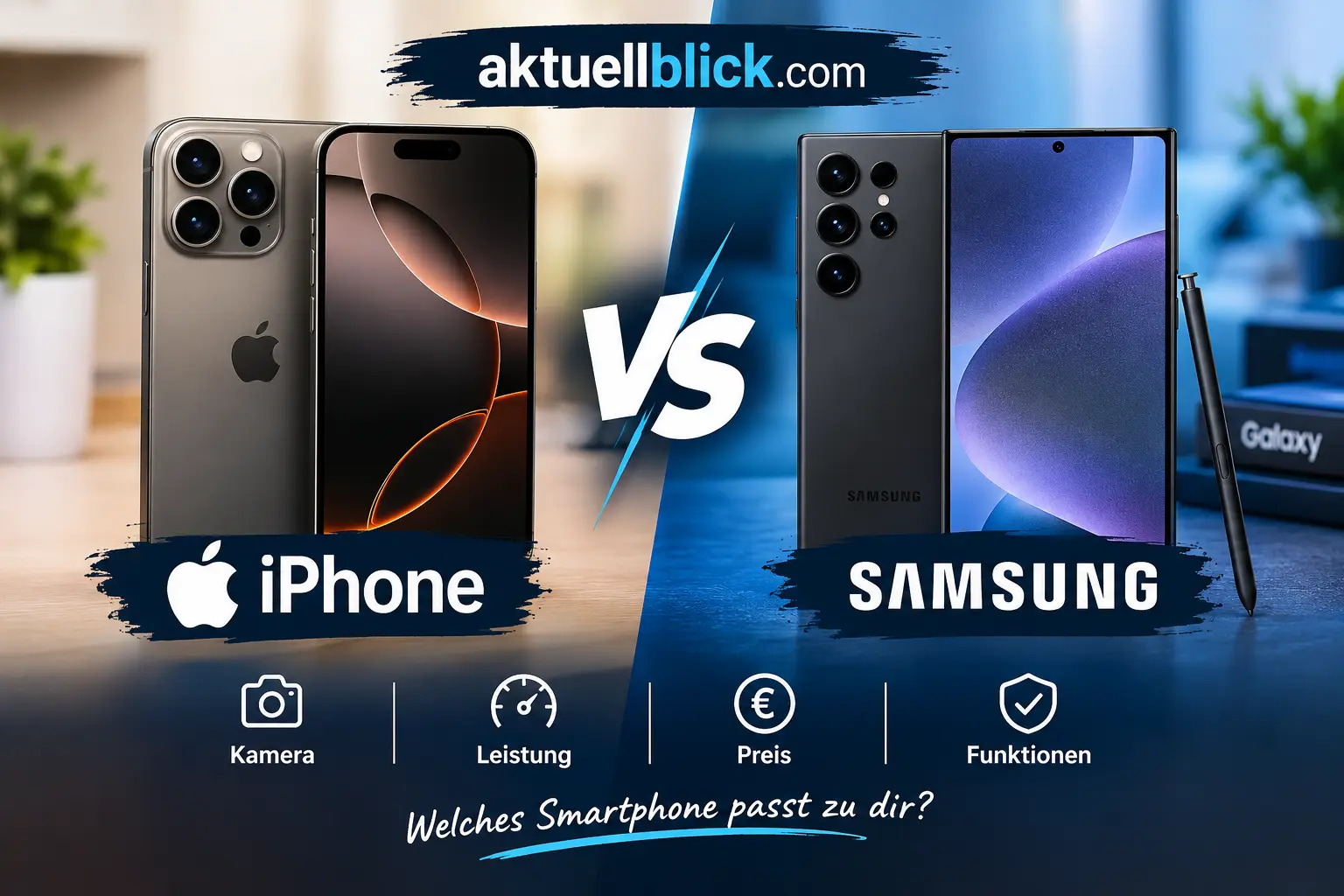

Choosing between an iPhone and a Samsung Galaxy phone in 2026 is no longer a simple choice between iOS and Android. Both brands now offer powerful processors, advanced cameras, high-refresh-rate displays, long software support, AI tools, strong security, and premium ecosystems.
The right iphone vs samsung choice depends on what you actually need from your phone. A student who mainly uses social media and messaging has different priorities from a photographer, gamer, business user, or someone who already owns a Mac, Apple Watch, Galaxy Book, or other connected devices.
The 2026 market has also changed significantly. Apple’s current lineup includes the iPhone 17 family, while Apple has now introduced the iPhone 18 Pro and iPhone 18 Pro Max with the A20 Pro chip, new camera technology, longer battery life, and iOS 27. Samsung’s Galaxy S26 family is its current flagship generation, including the Galaxy S26 Ultra with a 200MP main camera, 6.9-inch display, 5,000mAh battery, and Galaxy AI features.
That means an old comparison based on iPhone 15 versus Galaxy S24 is no longer enough. This guide explains the major differences, advantages, limitations, features, prices, ecosystem choices, AI capabilities, cameras, gaming performance, software, and buying considerations so you can make an informed decision without having to search for basic information elsewhere.
iPhone vs Samsung at a Glance
| Feature | iPhone | Samsung Galaxy |
|---|---|---|
| Operating system | iOS | Android with One UI |
| Current flagship generation | iPhone 18 Pro series and iPhone 17 family | Galaxy S26 series |
| AI platform | Apple Intelligence and Siri AI | Galaxy AI |
| Customization | More controlled | Extensive |
| App ecosystem | iOS App Store | Google Play Store + Galaxy ecosystem |
| Camera approach | Strong computational photography and video | High-resolution photography, zoom and AI-assisted imaging |
| Gaming | Strong hardware/software optimization | Strong performance and gaming features |
| Ecosystem | iPhone, Mac, Apple Watch, AirPods and more | Galaxy phones, tablets, watches, Buds, PCs and SmartThings |
| File sharing | AirDrop | Quick Share |
| Charging | USB-C and wireless charging | USB-C and wireless charging |
| Biometric security | Face ID on supported models | Fingerprint and facial recognition depending on model |
| Customization | More limited | Much more flexible |
| Productivity | Strong Apple ecosystem integration | Strong multitasking and Android/Windows integration |
This table is only a starting point. A phone can look better on a specification sheet while being less suitable for a particular person’s habits.
iPhone vs Samsung: What Is the Difference?
The biggest difference is the software philosophy.
Apple controls the iPhone hardware, operating system, processor design, services, App Store, and many accessories. This creates a tightly integrated experience. Samsung, meanwhile, builds Galaxy hardware around Android and adds its own One UI interface, Galaxy AI features, Samsung apps, multitasking tools, and ecosystem services.
In simple terms, iPhone generally gives you a more controlled and tightly integrated experience, while Samsung gives you more freedom to customize the phone and interact with Android’s broader ecosystem.
There is another important difference: Samsung sells phones across many price categories, from affordable Galaxy A-series models to premium Galaxy S and foldable devices. Apple’s current mainstream iPhone lineup is more concentrated around its premium smartphone strategy.
So, what does this mean for a normal buyer?
If you already use a Mac, Apple Watch, AirPods, or other Apple products, an iPhone can fit naturally into your existing setup. If you prefer Android flexibility, Windows integration, advanced multitasking, expandable customization options, or Samsung’s broader hardware range, Galaxy may make more sense.
Design and Build Quality
Modern flagship phones from both companies use premium materials and offer strong resistance against water and dust.
The iPhone 17, for example, uses an aluminum design, Ceramic Shield 2 on the front, and a glass back, with an IP68 rating.
Samsung’s Galaxy S26 Ultra uses an Armor Aluminum frame and Corning Gorilla Glass, while the phone is engineered for water resistance.
Design is largely subjective, but there are practical differences.
Apple emphasizes a recognizable, minimalist design with a tightly controlled hardware and software experience. Samsung offers a similarly premium appearance on its flagship range but provides more variation across its product families.
Weight and dimensions also matter. The standard Galaxy S26 is 6.3 inches and weighs 167 grams, while the Galaxy S26 Ultra is much larger at 6.9 inches and 214 grams.
For one-handed use, a smaller model may be easier regardless of brand. For watching videos, reading documents, editing photos, or multitasking, a larger screen can be more useful.
Display and Screen Technology
Samsung has traditionally placed significant emphasis on display technology, and the Galaxy S26 family continues that approach with Dynamic AMOLED 2X displays and 120Hz refresh rates. The standard S26 has a 6.3-inch FHD+ display, while the Ultra has a 6.9-inch display with a built-in Privacy Display.
The iPhone 17 also has a 6.3-inch Super Retina XDR OLED display with ProMotion adaptive refresh rates up to 120Hz, Always-On display support, HDR, True Tone, and a peak outdoor brightness rating of 3,000 nits.
Why does 120Hz matter?
A high refresh rate makes scrolling, animations, gaming, and supported applications feel smoother. It does not automatically make every part of the phone better, but it can noticeably improve the day-to-day experience.
For someone who watches movies, edits photographs, reads for long periods, or spends hours scrolling social media, display quality can be just as important as processor speed.
Samsung also has an unusual advantage with the Galaxy S26 Ultra’s Privacy Display. It is designed to reduce what people beside you can see on the screen when privacy is needed.
Performance and Speed
Performance is one area where both manufacturers are operating at an extremely high level.
The iPhone 17 uses Apple’s A19 chip with a six-core CPU, five-core GPU, Neural Engine, and hardware-accelerated ray tracing.
The iPhone 18 Pro models move to Apple’s A20 Pro and introduce a new vapor-chamber design intended to improve sustained performance during demanding workloads.
Samsung’s Galaxy S26 Ultra also focuses heavily on sustained performance, with Samsung highlighting improvements to CPU, GPU, and NPU performance over its previous Ultra generation.
But raw benchmark numbers should not be the only deciding factor.
A faster benchmark result does not automatically mean the phone will feel faster for your particular tasks. App optimization, thermal management, storage speed, operating system behavior, background processes, and software support all influence real-world performance.
For everyday activities such as WhatsApp, Instagram, YouTube, web browsing, email, banking, photography, and document editing, both flagship platforms provide more than enough performance.
iPhone vs Samsung Camera Comparison
Camera quality is one of the biggest reasons people compare these two ecosystems.
The important point is that camera performance is not determined only by megapixels. Image processing, sensor size, lens quality, stabilization, autofocus, dynamic range, HDR processing, computational photography, video processing, and software all affect the final image.
The standard iPhone 17 has a 48MP Fusion Main camera and 48MP Fusion Ultra Wide camera, while its main camera also provides an optical-quality 2x telephoto option.
Samsung’s Galaxy S26 uses a 50MP main camera, 12MP ultra-wide camera, and 10MP telephoto camera with 3x optical zoom.
The Galaxy S26 Ultra goes much further, using a 200MP wide camera, 50MP ultra-wide camera, and 50MP telephoto camera.
The iPhone 18 Pro generation adds another important development: a 48MP Fusion Main camera with variable aperture, giving users more control over depth of field and low-light photography.
Main Camera and Ultra-Wide Camera
The main camera is normally the lens people use most.
Apple’s approach generally emphasizes computational photography, color consistency, skin tones, HDR processing, and video quality. Samsung combines computational photography with high-resolution sensors and extensive camera controls.
Ultra-wide cameras are particularly useful for landscapes, architecture, group photographs, interiors, and travel.
A high-resolution ultra-wide sensor can preserve more detail when cropping, but lens quality and processing are still important. Simply seeing “48MP” or “50MP” on a specification sheet does not tell you exactly how a photograph will look.
When comparing cameras, look at actual samples taken in daylight, indoor lighting, difficult backlighting, moving subjects, and nighttime conditions.
Zoom and Telephoto Photography
Zoom is an area where Samsung’s flagship Ultra models are particularly focused.
The Galaxy S26 Ultra has a dedicated 50MP telephoto camera and advanced zoom capabilities, while the standard Galaxy S26 provides 3x optical zoom.
Dedicated telephoto cameras are valuable for photographing distant subjects without relying entirely on digital enlargement.
For example, someone photographing sports, concerts, wildlife, architecture, or distant details may care much more about telephoto performance than someone who mostly takes portraits and food photos.
Apple has also continued expanding its professional camera system. The iPhone 18 Pro models introduce variable aperture on the main camera and additional professional controls.
Night Photography and Portrait Mode
Night photography depends on more than camera resolution.
The phone needs to capture enough light, stabilize the image, combine multiple frames, reduce noise, preserve highlights, and maintain natural-looking colors.
Both ecosystems use computational photography heavily.
Samsung uses its ProVisual Engine and Galaxy AI-related image processing to enhance difficult scenes. Samsung specifically highlights improved nighttime imaging on the S26 family.
Apple combines sensor data, image processing, stabilization, and computational photography to produce photographs in low-light environments.
Portrait photography also involves depth detection and software processing. The quality of edge separation around hair, glasses, clothing, and complex backgrounds is often more important than the headline camera resolution.
Video Recording and Content Creation
For creators, video quality can be more important than still-photo resolution.
Important factors include stabilization, autofocus, exposure consistency, microphone quality, frame-rate options, HDR, color processing, editing tools, and how quickly footage can move from the phone to another device.
Apple has historically placed strong emphasis on video recording and creator workflows, while Samsung offers powerful video tools, high-resolution recording options, manual controls, and AI-assisted features.
Samsung’s standard Galaxy S26 supports 8K video recording at up to 30 frames per second according to its specifications.
The iPhone 18 Pro generation also adds professional camera controls and variable aperture, which can be useful for people who want greater creative control over footage and depth of field.
For TikTok, Instagram Reels, YouTube Shorts, travel videos, and professional social content, the best choice should be based on the complete workflow rather than a single camera specification.
Battery Life and Charging
Battery life depends on screen brightness, network signal, refresh rate, gaming, camera use, background applications, video streaming, and battery capacity.
Samsung publishes rated battery capacities for its S26 models: 4,300mAh for Galaxy S26, 4,900mAh for S26+, and 5,000mAh for S26 Ultra. Samsung also claims up to 31 hours of video playback for the S26 Ultra.
Apple does not normally make battery comparisons using the same simple mAh figure consumers see in Android specifications. Its battery performance depends on the hardware and software integration.
The iPhone 18 Pro Max is officially described by Apple as having its longest battery life in an iPhone, with up to 43 hours of video playback under Apple’s testing conditions.
Charging is another important difference. Samsung’s S26 Ultra can reach up to 75% charge in around 30 minutes under Samsung’s stated conditions. The standard S26 is advertised at up to 69% in around 30 minutes.
When comparing charging speeds, always check the required charger, charging conditions, cable, temperature, and battery state. Advertised maximum speeds are not necessarily maintained throughout the entire charging cycle.
AI Features in 2026
Artificial intelligence has become a normal part of flagship smartphones rather than a separate experimental feature.
Today’s AI smartphone features can help with writing, translation, image editing, search, summarization, voice assistance, productivity, photo organization, and contextual tasks.
Apple uses Apple Intelligence and Siri AI, while Samsung uses Galaxy AI.
The important question is not simply “Which phone has more AI?”
Instead, ask:
Which AI features will I actually use every week?
Some AI features are useful for almost everyone, such as removing unwanted objects from photographs, summarizing information, translating conversations, rewriting text, or finding information quickly.
Others are specialized and may not matter to a normal smartphone user.
Apple’s current iPhone platform integrates Apple Intelligence into supported experiences, while the iPhone 18 Pro generation adds newer Siri AI capabilities and additional personal-context functionality.
Samsung’s Galaxy S26 Ultra includes Galaxy AI tools such as Photo Assist, which allows users to describe certain image edits using natural-language prompts. Samsung also notes that AI feature availability can vary by country, device, operating system version, and carrier.
Apple Intelligence vs Galaxy AI
Apple’s AI strategy is closely connected to the company’s emphasis on privacy, personal context, and integration across its operating system.
Samsung’s strategy places strong emphasis on practical AI tools integrated into communication, photography, search, productivity, and device interactions.
Neither system should be judged solely by the number of AI features.
A better test is usefulness.
For example, if you frequently edit photos, AI object removal and generative editing can save time. If you write emails or messages all day, writing assistance can be valuable. If you regularly communicate in multiple languages, translation features may have greater practical value.
AI features can also change over time through software updates, so a phone’s AI capability at launch should not be treated as its permanent feature set.
Software and User Experience
The operating system is one of the most important long-term differences.
iPhone runs Apple’s iOS, while Galaxy phones run Android with Samsung’s One UI.
iOS focuses on consistency, controlled system behavior, tight hardware integration, privacy controls, and Apple’s ecosystem.
Android offers greater flexibility in areas such as home-screen customization, file handling, default applications, multitasking, and device interaction.
This difference affects small daily activities.
How do you organize your home screen? How do you share files? How do you handle notifications? How do you install applications? How much control do you want over the interface?
Those everyday interactions can matter more than a benchmark score.
iOS 26 vs Samsung One UI
For current buyers, software version matters because features change over time.
Apple’s current iPhone 17 specification pages now reference iOS 27, while the iPhone 18 Pro generation launched with iOS 27.
Samsung’s Galaxy S26 series uses Android with Samsung’s One UI interface.
One UI provides tools designed around Samsung hardware, including multitasking, customization, Galaxy AI, Samsung DeX on supported devices, and deeper integration with Samsung accessories.
iOS generally keeps the interface more standardized across supported iPhone models.
One UI is more flexible for users who want to modify the way their phone looks and behaves.
Software Updates and Long-Term Support
Long-term software support should be considered before buying an expensive phone.
A phone that remains secure and receives new features for years can provide better ownership value than a cheaper model that becomes outdated quickly.
Apple has a long history of supporting older iPhone models with major iOS updates.
Samsung has also substantially increased its software-support commitment for recent flagship Galaxy devices, making update longevity a much less one-sided consideration than it once was.
When buying, check the specific model’s support policy rather than assuming every phone from a brand receives identical treatment.
Security updates are especially important if the phone is used for banking, business accounts, passwords, authentication, or sensitive documents.
For the latest updates and insights, explore Chrome Hearts Glasses today.
Privacy and Security
Both ecosystems provide strong security, but they approach the subject differently.
Apple emphasizes permission controls, app tracking restrictions, encrypted services, secure authentication, and hardware-software integration. Apple states that supported iPhones include privacy protections around app tracking and encrypted communications such as iMessage and FaceTime.
Samsung and Android provide their own security architecture, biometric authentication, permission controls, secure hardware, and security-management tools.
Security also depends on the user.
Using a strong passcode, enabling two-factor authentication, installing updates, avoiding suspicious applications, and protecting account credentials are essential regardless of the brand.
No smartphone can compensate for unsafe user behavior.
Customization and Personalization
This is one of the clearest areas where Android remains attractive.
Samsung gives users extensive control over widgets, themes, icons, layouts, multitasking behavior, default applications, lock-screen options, and other interface elements.
iOS has become more customizable than older versions of Apple’s software, but Apple still maintains a more controlled environment.
For someone who wants the phone to look and behave in a highly personalized way, Samsung generally provides more room to experiment.
For someone who prefers a consistent interface that requires less configuration, Apple’s approach may be easier.
Ecosystem and Connected Devices
Your existing devices can be more important than the phone itself.
Apple’s ecosystem includes iPhone, Mac, Apple Watch, AirPods, iPad, Apple TV, iCloud, and other services.
Samsung’s ecosystem includes Galaxy smartphones, Galaxy tablets, Galaxy Watch, Galaxy Buds, SmartThings devices, and compatible Windows PCs.
The ecosystem becomes especially useful when several devices work together automatically.
For example, someone with a Mac and Apple Watch may value continuity features more than someone who primarily uses a Windows PC.
Likewise, someone already invested in Galaxy Buds, Galaxy Watch, Samsung tablets, or SmartThings devices may find Galaxy integration more useful.
AirDrop vs Quick Share
AirDrop and Quick Share solve a similar problem: transferring files between compatible devices without relying on traditional email attachments or third-party messaging services.
AirDrop is deeply integrated into Apple’s ecosystem.
Quick Share is Google’s and Samsung’s modern sharing solution and works across supported Android and compatible devices.
The better option depends heavily on the devices your friends, family, colleagues, and other devices use.
If most of your contacts use iPhones and Macs, AirDrop can be extremely convenient. If your world contains Android phones, Windows PCs, and Samsung devices, Quick Share can provide broader flexibility.
iPhone vs Samsung for Gaming
Gaming performance involves more than CPU speed.
Important factors include GPU performance, sustained thermal performance, display refresh rate, touch response, game optimization, battery behavior, storage, controller support, and the availability of games.
Both current flagship platforms are capable gaming devices.
Samsung’s Galaxy S26 Ultra uses a customized high-performance processor and Samsung highlights improvements in graphics and AI processing compared with the previous Ultra generation.
Apple’s A-series chips are also designed with powerful CPU and GPU performance, including hardware-accelerated ray tracing on the iPhone 17.
For serious gaming, compare the exact model rather than assuming every iPhone or Galaxy phone performs identically.
iPhone vs Samsung for Photography
Photography needs vary enormously.
A casual photographer may care about automatic point-and-shoot quality. A travel photographer may prioritize zoom. A creator may care about video. A professional user may want manual controls and consistent color.
Samsung’s Ultra models are particularly interesting for people who frequently use long-range zoom and high-resolution photography.
Apple’s Pro models appeal strongly to users who value video, computational photography, professional camera controls, and integration with creative workflows.
The best camera is therefore not simply the one with the largest megapixel number.
Look at the lenses you actually use.
If you photograph distant subjects every week, telephoto performance matters. If you mostly take family photographs and videos, autofocus, skin tones, stabilization, and video processing may matter more.
iPhone vs Samsung for Students
Students usually need a phone for communication, research, photographs, social media, productivity, entertainment, and sometimes gaming.
Battery life matters because students may spend long days away from a charger.
Storage also matters if the phone is used for video, photographs, downloaded lectures, documents, and applications.
A student who owns a MacBook and AirPods may benefit from an iPhone ecosystem.
A student using Windows, Google services, Samsung accessories, or Android applications may prefer Galaxy.
Budget should also be considered. There is no reason to spend flagship money if a less expensive phone already handles the student’s actual workload.
iPhone vs Samsung for Business and Productivity
Business users should look beyond email and messaging.
Consider calendar integration, document editing, cloud storage, authentication applications, video meetings, multitasking, file transfers, security, accessories, and compatibility with workplace systems.
Samsung’s Android and One UI environment offers powerful multitasking features and can be particularly useful for people who frequently work with multiple applications.
Apple’s ecosystem can be valuable for people who switch between an iPhone, Mac, iPad, and other Apple devices throughout the workday.
For business use, the correct choice often depends more on the company’s software environment than on the phone’s camera or processor.
iPhone vs Samsung for Everyday Use
For normal daily use, both platforms can comfortably handle:
- WhatsApp and messaging
- YouTube and streaming
- Instagram and TikTok
- Web browsing
- Online banking
- Maps and navigation
- Video calls
- Photography
- Music
- Social media
- Shopping
- Office applications
The difference appears in how those tasks are organized.
iOS tends to emphasize consistency and integration.
Samsung offers greater customization and multitasking flexibility.
The more heavily you personalize your phone, the more valuable Android’s flexibility can become. The more heavily you rely on Apple’s other devices, the more valuable ecosystem integration can become.
Storage Options and Pricing
Storage should be planned around how you use the phone.
128GB may be sufficient for a lighter user, while 256GB can be a better starting point for someone who takes many photographs, downloads videos, stores large games, or wants several years of use.
Heavy creators may need even more storage.
Pricing is also difficult to compare without specifying the exact model and country.
A base iPhone should not be compared with a Galaxy Ultra simply because both are called flagship phones. They occupy different positions in their respective lineups.
Always compare:
- Similar screen size
- Similar storage
- Similar performance class
- Similar camera capability
- Similar warranty
- Local taxes and import costs
- Official versus unofficial availability
This produces a much more useful price comparison.
Trade-In and Resale Value
Resale value can significantly change the real cost of ownership.
Suppose Phone A costs more initially but retains a higher percentage of its value after several years. Its effective ownership cost may be closer to that of a cheaper phone.
Trade-in values vary by country, model, storage, condition, carrier, and timing.
Before buying, check the expected resale market for the exact model rather than assuming every iPhone or Samsung device holds the same value.
Protecting the phone with a case and screen protector can also help preserve resale condition.
iPhone 17 vs Samsung Galaxy S26
This is one of the most useful mainstream comparisons for 2026.
The iPhone 17 has a 6.3-inch OLED display with up to 120Hz ProMotion, A19 processing, 48MP main and ultra-wide cameras, and Apple Intelligence.
The Galaxy S26 also has a 6.3-inch display with 120Hz refresh rate, a 50MP main camera, 12MP ultra-wide camera, 10MP telephoto camera with 3x optical zoom, and a 4,300mAh battery.
This comparison highlights an important difference in philosophy.
The iPhone focuses heavily on Apple’s integrated hardware, software, camera processing, and ecosystem.
The Galaxy S26 adds Samsung’s One UI, Android flexibility, dedicated telephoto hardware, Galaxy AI, and faster charging capabilities.
The better choice depends on which set of features matters most to you.
iPhone 17 Pro vs Samsung Galaxy S26 Ultra
This is a more direct premium comparison, although buyers should also consider the newer iPhone 18 Pro generation available in 2026.
The Galaxy S26 Ultra has a 6.9-inch display, 200MP main camera, 50MP telephoto camera, 5,000mAh battery, and built-in Privacy Display.
The iPhone 18 Pro and 18 Pro Max move Apple’s Pro lineup forward with the A20 Pro chip, a 48MP Fusion Main camera with variable aperture, new camera controls, improved battery performance, and iOS 27 with Apple Intelligence.
For buyers comparing current premium phones, it therefore makes more sense to consider the latest generation rather than automatically using the older iPhone 17 Pro as Apple’s top reference point.
Which iPhone and Samsung Models Should You Compare in 2026?
The correct comparison depends on your budget.
For mainstream flagship buyers, compare models with similar prices and physical size.
For premium buyers, compare the current Pro and Ultra models.
For budget-conscious users, look at Apple’s lower-priced iPhone options alongside Samsung’s Galaxy A-series rather than comparing a budget phone with a flagship.
For photography, prioritize models with dedicated telephoto cameras.
For gaming, prioritize sustained performance, cooling, display refresh rate, and battery behavior.
For business, prioritize productivity, ecosystem compatibility, security, and multitasking.
The model name alone does not tell you whether two phones are direct competitors.
iPhone vs Samsung for Different Types of Users
Different people should use different buying criteria.
For casual users: prioritize battery life, reliability, display quality, camera consistency, software support, and price.
For creators: prioritize video, camera controls, storage, microphones, stabilization, editing applications, and file transfer.
For gamers: prioritize GPU performance, thermal management, display refresh rate, battery life, and game optimization.
For business users: prioritize security, productivity, multitasking, cloud services, authentication, and ecosystem compatibility.
For students: prioritize battery, durability, storage, camera, price, and compatibility with existing devices.
For photographers: prioritize lens selection, zoom, sensor performance, RAW/manual controls where relevant, low-light performance, and editing workflows.
iPhone vs Samsung for Camera Lovers
Camera lovers should not make their decision based on megapixels alone.
Choose based on the type of photography you actually perform.
A person who takes portraits, family photographs, and short videos may prefer one camera system, while someone photographing concerts, wildlife, sports, or distant subjects may benefit more from Samsung’s advanced telephoto hardware.
The iPhone 18 Pro generation’s variable-aperture main camera is also important for enthusiasts who want more control over photography and depth of field.
iPhone vs Samsung for Battery Life
Battery results depend on the exact model.
The Galaxy S26 Ultra has a 5,000mAh battery and Samsung rates it for up to 31 hours of video playback.
Apple says the iPhone 18 Pro Max can deliver up to 43 hours of video playback under its specified testing conditions.
These figures should not be directly treated as laboratory equivalents because manufacturers use their own testing methodologies.
For real-world buying decisions, consider screen size, cellular reception, gaming habits, camera use, brightness, background activity, and charging access.
iPhone vs Samsung for AI Features
AI is most useful when it saves time.
For example, a useful AI phone can help summarize information, rewrite text, translate content, edit photographs, answer questions, organize information, or assist with everyday tasks.
Apple Intelligence is deeply integrated into Apple’s software environment, while Galaxy AI is closely connected with Samsung’s One UI and Galaxy hardware.
Samsung’s Photo Assist is one example of a practical AI feature: users can describe certain image edits in natural language.
Apple’s newer Siri AI direction focuses more heavily on personal context and system integration.
AI features can vary by region and language, so buyers outside the US should always check local availability.
iPhone vs Samsung for Customization
If customization is one of your highest priorities, Samsung provides more control.
You can modify many aspects of the interface, use widgets extensively, change launchers or defaults where supported, organize multitasking, and personalize the appearance more deeply.
Apple has added more customization over the years, but its approach remains more controlled.
This is not necessarily a quality issue. It is a difference in design philosophy.
Some people want freedom to configure everything.
Others want a polished system where fewer decisions are required.
iPhone vs Samsung Ecosystem Users
Your existing devices should heavily influence your decision.
If you own a Mac, Apple Watch, AirPods, iPad, and other Apple products, switching to Galaxy means giving up some of the convenience created by that ecosystem.
If you use Galaxy Watch, Galaxy Buds, Samsung tablets, SmartThings products, or Windows devices, Samsung can provide similarly useful integration.
The ecosystem is often the strongest reason to stay with a particular platform.
iPhone vs Samsung in Pakistan
The Pakistani market requires additional considerations that are easy to miss in US-based comparisons.
The biggest issue is PTA approval.
A phone imported into Pakistan may not have the same registration status as a device purchased through an authorized local channel. Buyers should verify the phone’s IMEI and registration requirements before assuming a device can be used permanently on local cellular networks.
Warranty is another important consideration.
An officially sold phone may have different warranty support from an imported or unofficial-market device.
Availability and pricing can also change quickly because exchange rates, taxes, import costs, retailer margins, and supply all affect local prices.
For Pakistani buyers, the cheapest advertised phone is therefore not necessarily the cheapest phone to own.
iPhone vs Samsung Price in Pakistan
There is no single permanent price difference because Pakistani smartphone pricing changes frequently.
Before buying, compare the complete cost:
- Phone price
- PTA registration status
- Official warranty
- Storage capacity
- Charger requirements
- Accessories
- Retailer reputation
- Repair availability
- Resale value
- Financing or installment costs
An unofficial imported device may appear cheaper initially but can create additional costs or warranty complications.
For an expensive flagship, buying from a reputable seller and confirming the exact model and PTA status is particularly important.
PTA Approval, Warranty and Network Compatibility
PTA approval should be checked separately from the phone’s brand.
An iPhone can be PTA-approved or non-PTA. The same applies to Samsung devices.
Network compatibility also depends on the exact regional model. Different countries can sell different variants with different supported cellular bands, SIM configurations, or features.
Before purchasing an imported phone, check:
- Exact model number
- IMEI status
- PTA registration requirements
- SIM and eSIM compatibility
- Supported cellular bands
- Local warranty
- Return policy
- Repair and parts availability
This is particularly important when purchasing from online marketplaces or individual importers.
Which Phone Offers Better Value in 2026?
Value is not the same as having the lowest price.
A phone’s real value comes from what you receive for the money and how long you can comfortably use it.
Consider the complete package:
Hardware: display, cameras, processor, battery and storage.
Software: operating system, updates, security and useful features.
Ecosystem: watches, earbuds, computers, tablets and smart-home devices.
Ownership: warranty, repairs, resale value and accessories.
Personal fit: whether the phone actually suits your habits.
A more expensive phone can be better value for one person and worse value for another.
Common Mistakes When Choosing Between iPhone and Samsung
One common mistake is comparing brands instead of specific models.
Another is choosing based only on megapixels.
Some buyers also compare battery capacity numbers without considering software optimization and actual usage.
Other mistakes include:
- Ignoring storage requirements
- Buying an imported phone without checking network compatibility
- Forgetting PTA registration in Pakistan
- Assuming every AI feature works in every country
- Ignoring software-support policies
- Choosing a phone that does not work well with existing accessories
- Buying more performance than necessary
- Comparing an Ultra model with a base iPhone
- Ignoring charging requirements
- Forgetting repair and warranty availability
- Assuming a higher price automatically means better value
The most expensive phone is not automatically the most appropriate phone.
How to Choose Between iPhone and Samsung
Start with your existing devices.
If you already have several Apple products, ecosystem compatibility should be near the top of your list.
If you use Windows, Android applications, Samsung accessories, or want extensive customization, Galaxy may fit your workflow more naturally.
Next, identify your most important feature.
If it is camera zoom, look at telephoto hardware.
If it is video, compare stabilization, recording formats, microphones, and editing workflows.
If it is gaming, compare sustained performance and thermal behavior.
If it is battery life, compare the exact models rather than brands.
If it is AI, check the features actually available in your country and language.
If it is price, calculate the total ownership cost, including warranty, PTA registration where applicable, accessories, and resale.
Finally, compare two specific phones at a similar price rather than trying to decide between two entire brands.
FAQs
Is iPhone or Samsung better in 2026?
There is no single answer for every buyer. The two platforms have different strengths in software, customization, ecosystem integration, cameras, AI, pricing, and hardware choices. Compare specific models according to your needs rather than choosing an entire brand.
Which has the better camera?
It depends on the type of photography. Samsung’s Ultra models place substantial emphasis on high-resolution photography and telephoto zoom, while Apple’s Pro models place strong emphasis on computational photography, video, consistency, and professional controls. The iPhone 18 Pro also introduces a variable-aperture main camera.
Which has better battery life?
Battery life depends on the exact model and usage pattern. Samsung’s Galaxy S26 Ultra has a 5,000mAh battery, while Apple says the iPhone 18 Pro Max provides its longest iPhone battery life yet. Manufacturer video-playback figures should not be treated as identical real-world tests.
Which phone charges faster?
Current Samsung flagship models advertise very fast wired charging, with Samsung stating that the S26 Ultra can reach up to 75% in around 30 minutes under its testing conditions. Charging speed varies by charger, cable, temperature, and battery state.
Which is better for gaming?
Both current flagship platforms provide high-end gaming performance. The exact model, GPU, cooling system, game optimization, display refresh rate, and sustained performance are more important than simply choosing one brand.
Which has better AI features?
Apple uses Apple Intelligence and Siri AI, while Samsung uses Galaxy AI. Their approaches differ, and feature availability can depend on model, country, language, carrier, and software version. Samsung explicitly notes regional variation for some Galaxy AI features.
Which is easier to customize?
Samsung generally provides more customization through One UI and Android. iOS offers increasing personalization but maintains a more controlled interface.
Which is better for students?
Either can work well. Students should prioritize battery life, storage, durability, camera quality, price, software support, and compatibility with their existing laptop and accessories.
Which is better for business?
The best choice depends on the workplace ecosystem. Apple can be particularly convenient for Mac users, while Samsung offers strong Android, Windows, multitasking, and productivity integration.
Can I switch from Samsung to iPhone?
Yes. Contacts, photographs, calendars, files, and many other types of information can be transferred using Apple’s migration tools and cloud services. However, some Android-specific applications, settings, accessories, and messaging behavior may work differently after switching.
Can I switch from iPhone to Samsung?
Yes. Samsung provides migration tools for moving supported data from iPhone to Galaxy. You should still check which applications, passwords, services, and accessories need to be configured again.
Which has better privacy?
Both platforms provide strong security and privacy controls. Apple emphasizes privacy as a core part of its hardware and software design, while Samsung and Android provide extensive permission, authentication, and security features. Safe user behavior remains essential on either platform.
Is iPhone or Samsung better in Pakistan?
The answer depends on the specific model, price, PTA status, warranty, network compatibility, and your existing devices. Pakistani buyers should check these factors before focusing on the brand.
Should I buy an imported phone in Pakistan?
An imported phone can sometimes cost less, but you should verify its exact model, PTA requirements, IMEI status, network-band compatibility, warranty, and return policy before buying.
Does a higher megapixel camera mean better photos?
No. Megapixels describe image resolution, not overall camera quality. Sensor size, lens quality, stabilization, autofocus, image processing, dynamic range, and software all influence the final photograph.
Do I need a flagship phone?
Not necessarily. If you mainly use messaging, browsing, social media, streaming, navigation, and basic photography, a mid-range phone can be sufficient. Flagships become more useful when you need advanced cameras, gaming performance, premium displays, long-term performance, or specialized features.
Conclusion
The 2026 smartphone market makes the decision more interesting because both Apple and Samsung now offer mature, highly capable platforms.
The important question is not simply which brand has the most impressive specification sheet. It is which phone fits your actual habits.
Look at the exact model, camera system, battery behavior, display, software, AI features, ecosystem, customization, warranty, local availability, and total ownership cost.
For Pakistani buyers, PTA approval, warranty and network compatibility deserve special attention. For creators, camera and video workflows should carry more weight. For gamers, sustained performance and thermals matter. For students, battery, storage and price are often more practical concerns. For ecosystem users, compatibility with existing computers, watches, earbuds and tablets can influence the experience every day.
Apple’s newest Pro generation has moved forward with the A20 Pro, variable-aperture camera technology, improved battery performance and newer AI capabilities, while Samsung’s Galaxy S26 Ultra continues to emphasize high-resolution photography, zoom, Galaxy AI, fast charging, large displays and productivity features.
The smartest purchase is therefore the one that matches your priorities rather than the one with the longest specification list.
For the latest updates and insights, explore Chrome Hearts Glasses today.