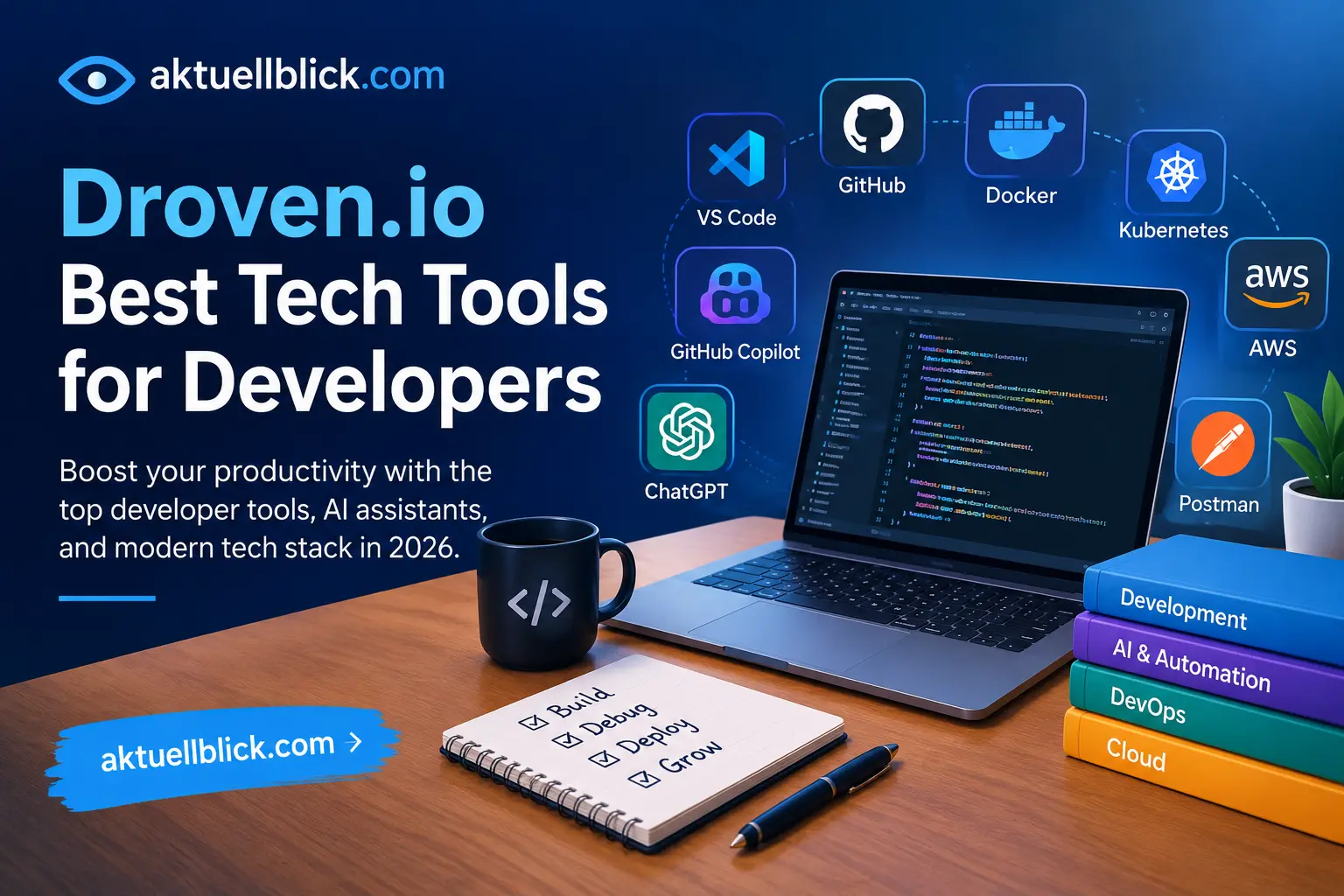

Choosing the right software development tools can make a significant difference in how quickly, securely, and efficiently developers build applications. In 2026, the development landscape includes AI coding assistants, intelligent code editors, automated testing platforms, cloud infrastructure, and deployment services that help simplify even complex engineering tasks. However, finding the right combination is not always easy, especially when dozens of tools claim to improve productivity.
The growing interest in droven.io best tech tools for developers reflects a broader need for practical guidance on selecting technologies that genuinely solve development problems. Rather than choosing software simply because it is popular, developers need to understand what each tool does, how it fits into a workflow, and whether its benefits justify the cost and learning curve. This guide explores the droven.io best tech tools for developers topic by examining essential development software, AI-powered coding solutions, testing frameworks, cloud platforms, and productivity tools.
Whether you are learning your first programming language, building a freelance project, managing a startup, or maintaining enterprise applications, this guide will help you understand the available options and build a practical development toolkit without unnecessary complexity.
What Is Droven.io and How Does It Help Developers?
Droven.io is a technology-focused editorial website that covers subjects such as artificial intelligence, software development, digital transformation, technology tools, and related industry developments. It can serve as a discovery point for readers who want to explore emerging technologies and learn about software that supports modern development workflows.
It is important to understand the difference between a technology publication and a software product. An editorial website provides information, explanations, comparisons, and recommendations. A developer tool, by contrast, is an application or service that performs a specific technical function, such as editing code, testing an API, managing databases, or deploying an application.
For example, Visual Studio Code helps developers write and debug code, Docker packages applications into containers, and Postman supports API development and testing. These are independent products, not components of one unified Droven.io development environment.
How can developers benefit from a technology discovery website? They can use editorial content to identify unfamiliar tools, understand their intended purposes, compare alternatives, and decide what to investigate further. Before adopting a recommendation, however, developers should verify current capabilities, licensing, security practices, and compatibility with their projects.
A useful technology guide should answer three practical questions: What problem does a tool solve? Who benefits most from using it? What limitations should users understand before committing to it?
Is Droven.io a Developer Tool or a Technology Information Platform?
Droven.io should be understood as a technology information platform rather than a code editor, integrated development environment, or complete software development suite.
This distinction matters because searching for a particular tool is different from searching for information about tools. A developer looking for an application that generates code needs an actual coding assistant. Someone researching development software may benefit from an editorial resource that explains several alternatives.
Consider the following comparison:
| Category | Purpose | Example |
|---|---|---|
| Technology publication | Explains technologies and helps readers discover tools | Droven.io |
| Code editor | Provides an environment for writing and editing source code | Visual Studio Code |
| AI coding assistant | Helps generate, explain, and modify code | GitHub Copilot |
| Version control platform | Tracks code changes and supports collaboration | GitHub |
| API testing tool | Sends requests and checks API behavior | Postman |
| Containerization platform | Packages applications and dependencies consistently | Docker |
| Cloud platform | Provides computing, storage, databases, and managed services | AWS |
A publication may discuss these products, but discussing a tool does not mean owning, developing, or officially endorsing it.
When researching software through technology articles, check whether the information distinguishes verified product features from opinions. Also look for clear explanations of limitations, intended users, and practical use cases. These details are more useful than a simple list of popular applications.
Droven.io Best Tech Tools for Developers in 2026: An Overview
The most useful developer toolkit usually combines a small number of complementary applications. Instead of installing every popular product, begin with tools that cover coding, source control, testing, deployment, and troubleshooting.
The following overview identifies widely used options and the problems they help solve.
| Developer tool | Main purpose | Best suited for |
|---|---|---|
| Visual Studio Code | Code editing and debugging | General software development |
| Cursor | AI-assisted coding | Developers who want AI integrated into their editor |
| IntelliJ IDEA | Java and JVM development | Professional Java developers |
| GitHub Copilot | AI coding assistance | Individual developers and engineering teams |
| Claude Code | Agent-based coding and repository tasks | Developers working on complex codebases |
| OpenAI Codex | AI-assisted coding and delegated software tasks | Developers who want help with implementation |
| Git and GitHub | Version control and collaboration | Almost every development team |
| Postman | API design and testing | Backend and integration developers |
| Playwright | Browser automation and testing | Web application teams |
| Docker | Container-based development | Developers and DevOps engineers |
| GitHub Actions | Workflow automation and CI/CD | Teams automating builds and tests |
| Terraform | Infrastructure as code | Cloud and platform engineers |
| Supabase | Database and backend services | Web and mobile application developers |
| Vercel | Application deployment | Frontend and full-stack developers |
| Sentry | Error tracking and performance monitoring | Teams maintaining production applications |
This is a practical shortlist, not a universal ranking. A beginner may need only a code editor, Git, and a browser. A team operating a large cloud application may also need automated testing, infrastructure management, monitoring, and security controls.
The right selection depends on the application’s complexity, programming language, budget, team size, and reliability requirements.
Why Developers Need the Right Tech Tools in 2026
Software development involves much more than writing code. Developers must understand requirements, design systems, review changes, diagnose bugs, test applications, manage dependencies, protect sensitive information, and maintain software after release.
The right tools reduce repetitive work and make these responsibilities easier to manage.
Higher productivity: Code completion, reusable templates, automated testing, and AI-assisted debugging can reduce time spent on routine tasks.
Better code quality: Linters, static analyzers, type checkers, and automated tests identify problems before they reach production.
More reliable collaboration: Version control, pull requests, shared documentation, and project management systems help teams coordinate their work.
Consistent development environments: Containers and dependency management tools reduce the familiar problem of software working on one computer but failing on another.
Faster troubleshooting: Error tracking and application monitoring provide evidence about failures instead of forcing developers to guess what happened.
Improved security: Dependency scanning, secret detection, code analysis, and controlled deployment workflows help reduce avoidable risks.
AI has expanded these possibilities by allowing developers to ask questions about unfamiliar code, generate test cases, plan changes, and delegate certain implementation tasks. However, automation does not eliminate engineering responsibility. Developers must still evaluate correctness, performance, security, and maintainability.
The goal is not to automate every task. It is to remove unnecessary friction while preserving control over important technical decisions.
How to Choose the Best Developer Tools for Your Workflow
Selecting software becomes easier when you begin with a real problem instead of a product name.
For example, if you repeatedly struggle to understand an unfamiliar codebase, a repository-aware AI assistant may help. If your application works locally but fails in staging, containerization and environment configuration deserve attention. If users report errors that you cannot reproduce, production monitoring may be more valuable than another code editor.
Evaluate each tool against these criteria:
- Problem fit: Does it solve a recurring problem in your workflow?
- Compatibility: Does it support your programming language, framework, operating system, and existing services?
- Learning curve: Can you use it effectively without spending excessive time configuring it?
- Integration: Does it work with your editor, repository, testing framework, and deployment pipeline?
- Security: How does it handle source code, credentials, customer information, and other sensitive data?
- Reliability: Does it behave consistently, and can you troubleshoot failures?
- Total cost: Consider subscriptions, usage limits, cloud consumption, maintenance, and training.
- Scalability: Will the tool remain useful as your project or team grows?
- Portability: Can you export your data or migrate away without significant disruption?
- Measurable value: Does it improve delivery speed, reduce defects, or simplify maintenance?
A simple way to compare alternatives is to test them on the same representative task. Measure completion time, setup effort, errors, review requirements, and ongoing costs.
Avoid choosing a tool because it has the largest feature list. A lightweight application that reliably solves your problem may be more valuable than a sophisticated platform that adds unnecessary complexity.
Best Code Editors and Integrated Development Environments for Developers
Code editors and integrated development environments, commonly called IDEs, provide the foundation for writing, navigating, testing, and debugging software.
A code editor typically focuses on source-code editing and can gain additional capabilities through extensions. An IDE generally integrates more language-specific functionality, such as advanced debugging, project navigation, build tools, and refactoring features.
The distinction is not absolute. Modern editors can provide many IDE-like capabilities, while some IDEs support lightweight workflows.
When choosing between them, consider your primary programming language, project size, debugging needs, extension requirements, and hardware limitations.
Visual Studio Code: A Versatile Editor for Modern Development
Visual Studio Code, commonly called VS Code, is a flexible source-code editor suitable for web development, Python programming, scripting, and many other software projects.
Its main strengths include IntelliSense code completion, integrated debugging, terminal access, source control integration, customizable extensions, and support for numerous programming languages.
Developers can install extensions for TypeScript, Python, PHP, Java, C++, container development, remote environments, and AI-assisted coding. This flexibility makes VS Code a practical starting point for beginners and experienced programmers alike.
Its integrated terminal allows developers to run commands without constantly switching applications. Git integration makes it easier to inspect file changes, stage modifications, and commit code.
VS Code is particularly useful for:
- Frontend development with JavaScript, TypeScript, HTML, and CSS.
- Backend development with Python, Node.js, PHP, and supported frameworks.
- Editing configuration files, scripts, and infrastructure definitions.
- Working with remote development environments and containers.
- Integrating AI coding assistants into an existing workflow.
Its main limitation is that a large collection of extensions can increase complexity and introduce compatibility or security concerns. Some language ecosystems also benefit from a more specialized IDE.
Who should choose VS Code? Developers who want a customizable, general-purpose environment without committing to a heavyweight IDE can start here and add capabilities as their needs evolve.
Cursor: AI-Powered Code Editing and Development
Cursor is an AI-focused code editor designed to integrate coding assistance into everyday development.
It can help developers understand repositories, generate code, make changes across multiple files, and work through implementation tasks using natural-language instructions. Depending on the current model and enabled features, developers can also use it for refactoring, debugging assistance, and test generation.
For example, a developer might ask an AI coding editor to identify where a form is validated, explain the related components, and propose a change to the validation rules. The developer can then inspect the suggested modifications, run the tests, and accept or revise the changes.
Cursor is especially useful when:
- Working with unfamiliar codebases.
- Making coordinated changes across multiple files.
- Generating boilerplate code and test cases.
- Exploring alternative implementations.
- Reducing repetitive editing tasks.
However, AI-generated changes can introduce subtle bugs, modify unrelated files, or misunderstand project requirements. Developers should inspect diffs, run automated tests, and avoid granting unnecessary access to sensitive files.
Pricing, model availability, usage limits, and specific features can change. Review the current plan details before selecting a subscription.
Cursor is a strong option for developers who want AI integrated deeply into the editing process, but it is not automatically better than every conventional editor or AI extension.
IntelliJ IDEA: A Powerful IDE for Professional Developers
IntelliJ IDEA is a full-featured IDE primarily associated with Java and JVM development. It provides advanced code navigation, refactoring, debugging, testing integrations, and project analysis.
Its intelligent code assistance can help developers understand relationships between classes, identify potential errors, and make structural changes across large projects.
IntelliJ IDEA is particularly suitable for enterprise Java applications, Spring-based systems, and projects that require sophisticated navigation and refactoring capabilities. Support for other languages and frameworks depends on the edition, installed plugins, and current product configuration.
Its advantages include:
- Strong Java code analysis and navigation.
- Integrated debugging and testing workflows.
- Refactoring support for large codebases.
- Build-tool integration.
- Useful features for complex multi-module projects.
The trade-off is that a full IDE may require more system resources than a lightweight editor. Some advanced capabilities may also require a paid edition.
Choose IntelliJ IDEA when its language-specific functionality saves more time than the additional setup and resource requirements. For developers working mainly with JavaScript, HTML, or lightweight scripts, a simpler editor may be sufficient.
Best AI Coding Assistants and Autonomous Coding Agents in 2026
AI coding assistants have developed beyond basic autocomplete. Depending on the product and enabled capabilities, they can explain unfamiliar code, suggest functions, generate tests, summarize changes, inspect repositories, and assist with multi-step implementation.
AI coding agents take this further by working through a task using a sequence of actions. An agent may inspect relevant files, propose a plan, modify code, execute permitted commands, and report the results.
These systems can be useful for repetitive implementation, exploratory programming, debugging, and maintenance. Their effectiveness depends on task complexity, repository context, model quality, available tools, and the quality of the instructions.
The following products address different needs rather than offering identical experiences.
GitHub Copilot for Code Generation, Debugging, and Testing
GitHub Copilot provides AI-assisted coding capabilities through supported editors and GitHub workflows. Depending on the current plan and integration, it can offer inline suggestions, conversational assistance, code explanations, test generation, and agent-based development features.
A developer writing a function can use Copilot to suggest an implementation. Another developer might ask it to explain a complicated method or propose test cases for edge conditions.
It can be useful for:
- Generating repetitive code and boilerplate.
- Understanding unfamiliar functions.
- Drafting unit tests.
- Suggesting refactoring approaches.
- Assisting with code review and development workflows.
- Exploring solutions to programming errors.
Copilot is particularly convenient for teams already using GitHub and supported IDEs. Its integration can reduce the need to switch between separate applications.
However, generated code can contain incorrect assumptions, outdated patterns, licensing concerns, or security vulnerabilities. Suggestions should be reviewed like any other code contribution.
Before adopting Copilot for a professional project, check the current subscription features, organizational controls, data policies, and model availability. The exact capabilities differ across plans and integrations.
Claude Code for Complex Coding Tasks and Codebase Analysis
Claude Code is an agent-based coding tool designed to help developers work with repositories, understand project structure, modify files, and perform coding tasks through supported interfaces, including terminal-based workflows.
Rather than relying exclusively on small inline suggestions, developers can give it a task that involves several related steps. For example, they might request an explanation of a failing test, an investigation of the relevant implementation, and a proposed fix with additional test coverage.
Useful applications include:
- Exploring unfamiliar repositories.
- Refactoring related components.
- Investigating errors across multiple files.
- Drafting tests and documentation.
- Performing structured code changes.
- Supporting maintenance of existing applications.
Its usefulness depends on how clearly the task is described and how much relevant context is available. Large tasks may require several iterations, and proposed modifications still need verification.
Developers should review file changes, understand commands before approving them, and limit access to secrets and unrelated directories. For production repositories, use branch protection, automated tests, and normal code review procedures.
Claude Code is worth considering when a developer needs more than autocomplete and wants assistance with multi-step engineering work.
OpenAI Codex for AI-Assisted Software Development
OpenAI Codex is an AI coding agent offering coding assistance for supported development workflows. Depending on the current product interface and configuration, developers can delegate implementation tasks, request code changes, work through bug fixes, and review proposed solutions.
A typical task might involve asking an agent to add validation to an existing form, write tests for the new behavior, and explain the changes. The developer then checks the resulting code and decides whether to merge it.
Codex can be useful for:
- Implementing clearly defined features.
- Fixing reproducible bugs.
- Generating and updating tests.
- Exploring repository structure.
- Working through coding tasks that can be reviewed independently.
- Supporting development across existing codebases.
The key advantage of delegating a task is that it can free developers to focus on requirements, architecture, and review rather than every mechanical editing step.
However, delegation is not the same as correctness. An agent may misunderstand requirements, introduce regressions, or fail to account for undocumented behavior. Large architectural changes are especially likely to require human direction.
Start with well-scoped tasks, provide relevant instructions, and evaluate the output through tests and code review. Confirm current availability, plan limits, and execution options before building a workflow around the product.
Google Gemini CLI and Amazon Q Developer for AI-Powered Programming
Google Gemini CLI and Amazon Q Developer support AI-assisted development through different ecosystems and workflows.
Gemini CLI is a terminal-based AI assistant that can help with coding questions, repository analysis, explanations, and supported development tasks. Developers who prefer command-line workflows may find this approach more natural than working entirely through a graphical editor.
Amazon Q Developer is particularly relevant to teams using AWS. Depending on the supported environment and current product capabilities, it can assist with code generation, explanations, troubleshooting, and cloud-development tasks.
Their main differences are practical:
- Gemini CLI: Consider it when you want terminal-based AI assistance and flexible development workflows.
- Amazon Q Developer: Consider it when your projects involve AWS services, cloud configuration, or AWS-centered development processes.
Neither product eliminates the need to understand the underlying infrastructure. Developers must still verify IAM permissions, cloud configuration, resource costs, and deployment security.
Check current model access, usage limits, supported IDEs, and account requirements. Select the product that fits your workflow rather than assuming that one assistant will perform equally well across every language and cloud environment.
Replit Agent for Rapid Application Development and Prototyping
Replit Agent helps users create and modify applications through natural-language instructions within Replit’s development environment.
It is especially appealing to beginners, educators, founders, and developers who want to move quickly from an idea to a working prototype. Depending on current capabilities, an agent-assisted workflow can help create application structures, write code, troubleshoot errors, and support deployment.
For example, a founder might describe a basic appointment-booking application with user accounts, a calendar, and an administrative dashboard. The agent can help establish an initial implementation that the founder or developer can refine.
Replit can be useful for:
- Building proof-of-concept applications.
- Learning programming through practical projects.
- Creating internal tools.
- Testing interface ideas.
- Developing simple web applications.
- Collaborating in a browser-based environment.
Its limitations become more important as requirements grow. Complex applications may need careful architecture, stronger testing, detailed access controls, database planning, and a deployment strategy beyond the initial prototype.
Always inspect generated code and confirm how authentication, data storage, secrets, backups, and deployment are handled. A working demonstration is not automatically a production-ready application.
AI Coding Assistants vs. AI Agents: What Is the Difference?
An AI coding assistant primarily supports a developer while they work. An AI coding agent can take a more active role in completing a defined task by planning steps, using permitted tools, and making changes.
| Feature | AI coding assistant | AI coding agent |
|---|---|---|
| Typical interaction | Suggests or explains code | Works through a defined task |
| Scope | Often focused on immediate questions or edits | May span several files and steps |
| Developer involvement | Frequently continuous | Can involve delegated work followed by review |
| Tool execution | Depends on the product | Often central to the workflow |
| Main risk | Incorrect suggestions | Incorrect changes or unintended actions across a larger scope |
| Best use | Everyday coding support | Multi-step implementation and maintenance |
The distinction is not absolute. Many modern products combine assistant and agent capabilities, and features differ by plan and configuration.
For simple tasks, an inline suggestion may be enough. For a cross-file refactor, an agent may be more convenient if the task is clearly defined and the environment is appropriately restricted.
The safest workflow is to delegate bounded tasks, inspect the changes, run tests, and retain human approval for consequential decisions.
How to Use AI Coding Tools Without Sacrificing Code Quality
AI-assisted programming works best when developers treat generated output as a proposed implementation rather than unquestionable truth.
Start by describing the intended behavior, constraints, relevant files, and acceptance criteria. Instead of asking an assistant to improve an entire application, ask it to make a specific change and explain how success will be measured.
A reliable workflow includes the following steps:
- Understand the task: Define what must change and what must remain unchanged.
- Provide relevant context: Share necessary code, architectural conventions, and error messages without exposing secrets.
- Request a plan: For larger tasks, ask for a short implementation plan before approving modifications.
- Make changes in a controlled branch: Keep work isolated so it can be reviewed or reverted.
- Run automated tests: Execute unit tests, integration tests, and relevant end-to-end checks.
- Review the diff: Look for unrelated modifications, missing validation, and unexpected dependencies.
- Check security: Inspect authentication, authorization, input validation, and data handling.
- Measure the outcome: Confirm that the requested behavior works and no existing functionality has broken.
- Document important decisions: Record architectural choices and non-obvious changes.
AI-generated tests can also be incomplete. A model might produce tests that confirm its own incorrect assumptions, so include edge cases and independently verify expected behavior.
The objective is not simply to generate more code. It is to deliver correct, maintainable software with less unnecessary effort.
Best Version Control and Collaboration Tools for Developers
Version control systems record how source code changes over time. They make it possible to compare versions, recover earlier work, create branches, and collaborate without relying on manually copied folders.
For professional development, version control is a core requirement rather than an optional productivity feature.
Git is the underlying distributed version control system used by many teams. Hosting platforms such as GitHub, GitLab, and Bitbucket add repository management, pull requests or merge requests, issue tracking, access controls, and collaboration features.
These platforms support different workflows, but the essential goal is the same: make changes traceable, reviewable, and recoverable.
Developers should use meaningful commit messages, keep changes focused, protect important branches, and review code before merging. Teams should also agree on conventions for branches, release tags, and handling merge conflicts.
Git and GitHub for Source Control and Team Collaboration
Git tracks changes in a repository, while GitHub provides a hosted environment for collaborating around Git repositories.
A branch allows a developer to work on a feature without immediately changing the main development line. A commit records a set of changes, and a pull request lets teammates review proposed modifications before merging them.
GitHub also supports issues, project coordination, automation, security features, and code review workflows.
A basic development cycle looks like this:
- Create or update a feature branch.
- Make focused code changes.
- Run local checks and tests.
- Commit the work with a descriptive message.
- Push the branch to the repository.
- Open a pull request and request review.
- Resolve feedback and allow required checks to finish.
- Merge only when the change satisfies the project’s requirements.
Git and GitHub are useful for individual projects as well as large teams. Even solo developers benefit from having a history of changes and a straightforward recovery process.
Remember that version control is not a complete backup strategy. Important repositories and associated data may need separate backups, retention policies, and recovery testing.
Best API Development and Testing Tools
An application programming interface, or API, allows software components to communicate. APIs commonly connect web frontends to backends, mobile applications to servers, and separate services within larger systems.
API development tools help developers inspect endpoints, send requests, examine responses, validate authentication, and test error handling.
When evaluating an API, developers should consider more than whether a successful request returns the expected data. They should also check authorization, input validation, rate limiting, error responses, pagination, and performance.
Useful tools include Postman, Insomnia, command-line utilities such as cURL, and automated testing libraries integrated into application code.
The best choice depends on whether you need an interactive interface, automated regression testing, team collaboration, or command-line scripting.
Postman for API Design, Testing, and Debugging
Postman provides a workspace for creating and sending API requests, inspecting responses, organizing collections, and supporting API testing workflows.
Developers can configure HTTP methods, request headers, query parameters, authentication, and request bodies. Responses can then be checked for status codes, headers, content, and timing.
For example, when testing a login endpoint, a developer can examine whether valid credentials return the expected response and whether invalid credentials produce an appropriate error without exposing sensitive information.
Postman is useful for:
- Testing REST APIs and supported API protocols.
- Organizing requests into collections.
- Managing environment variables.
- Checking authentication behavior.
- Documenting API workflows.
- Supporting repeatable testing and collaboration.
A well-organized collection can help new team members understand how a service behaves without manually reconstructing every request.
However, developers should never store production passwords, access tokens, or private customer data carelessly in shared workspaces. Use appropriate secret management, access controls, and environment separation.
For automated regression testing, integrate API checks into a repeatable pipeline rather than relying exclusively on manual requests.
Best Software Testing and Debugging Tools for Developers
Software testing determines whether an application behaves as expected. Debugging helps identify why it does not.
Different testing levels address different risks:
- Unit testing: Checks individual functions or components.
- Integration testing: Verifies interactions between modules, services, or databases.
- End-to-end testing: Checks complete user workflows.
- Performance testing: Measures response times, throughput, and resource usage.
- Security testing: Looks for vulnerabilities and unsafe behavior.
- Regression testing: Checks that changes have not broken existing functionality.
Tools such as Jest, Vitest, pytest, JUnit, Playwright, Selenium, and browser developer tools support different parts of this process.
No single testing framework covers every requirement. A web application might use unit tests for business logic, API tests for backend behavior, and browser automation for critical user journeys.
Debugging also requires evidence. Logs, stack traces, breakpoints, network inspection, and reproducible test cases can help narrow down the cause of a failure.
Testing should begin early in development and continue through deployment. Finding a defect before release is generally easier than diagnosing it after users encounter it in production.
Playwright for Automated Web Application Testing
Playwright is a browser automation and end-to-end testing framework that supports modern web application testing across Chromium, Firefox, and WebKit.
It allows developers to automate browser actions, interact with page elements, verify expected behavior, and capture useful debugging evidence. Its locator and auto-waiting capabilities help reduce certain timing-related problems in browser tests.
For example, a team can write a test that opens a login page, enters credentials, submits the form, and verifies that the correct dashboard appears.
Playwright is particularly useful for:
- Testing critical user journeys.
- Checking forms and navigation.
- Running tests across browser engines.
- Supporting continuous integration.
- Investigating failures through traces, screenshots, and related debugging features.
It is a strong choice for modern web applications that need repeatable browser-based tests.
However, tests still require maintenance. Fragile selectors, uncontrolled test data, and dependence on external services can make a suite unreliable. Use stable locators, isolate test data where practical, and avoid testing every possible detail through the browser when a faster unit or integration test would suffice.
Selenium for Cross-Browser Testing and Automation
Selenium is a widely used browser automation framework that allows developers to control supported browsers through WebDriver and related tools.
It is useful for automating browser interactions, testing web applications, and integrating browser-based checks into established testing environments. Its ecosystem and language support make it relevant to teams with existing automation infrastructure.
Selenium may be a good fit when an organization already has a mature test suite or requires a particular integration supported by its ecosystem.
Playwright is often attractive for teams starting new web automation projects because of its integrated testing experience and built-in debugging facilities. Selenium remains valuable where its compatibility, existing infrastructure, or established test architecture makes it the more practical choice.
The decision should be based on test requirements, browser coverage, team experience, CI infrastructure, and maintenance effort rather than popularity alone.
Code Quality, Static Analysis, and Automated Code Review Tools
Code quality tools identify potential problems before they become difficult to fix.
Static analysis examines code without necessarily executing the application. Depending on the tool, it can identify suspicious patterns, type errors, maintainability issues, security risks, and violations of coding standards.
Common examples include ESLint for JavaScript and TypeScript linting, Ruff for Python linting and related checks, SonarQube for code quality and security analysis, and language-specific type checkers.
Automated code review tools can also highlight questionable changes or explain potential issues in a pull request. AI-powered review should complement established checks rather than replace them.
A practical quality workflow combines:
- Formatting and linting.
- Type checking where supported.
- Unit and integration tests.
- Dependency and secret scanning.
- Static application security testing.
- Human review of significant changes.
Not every warning indicates a serious defect, and overly strict rules can create unnecessary friction. Configure checks around the project’s language, risk profile, and standards.
The objective is consistent, maintainable code—not the largest possible number of automated warnings.
Best Database and Backend Development Tools
Backend development handles the logic and services behind an application. This may include authentication, business rules, database access, background jobs, file storage, and API endpoints.
Database tools help developers design schemas, query records, manage migrations, inspect performance, and protect data integrity.
Common technologies include PostgreSQL, MySQL, SQLite, MongoDB, Redis, and managed database services. The best choice depends on the application’s data model, consistency requirements, workload, and operational resources.
Relational databases such as PostgreSQL are useful when structured relationships, transactions, and strong data integrity matter. Document databases can suit certain flexible data models, while Redis is commonly used for caching and other low-latency data-access patterns.
Backend frameworks and managed services can reduce implementation effort, but they do not eliminate the need for good database design.
Developers should plan indexes, migrations, backups, access permissions, monitoring, and recovery procedures before a project becomes business-critical.
Supabase for Database Management and Backend Services
Supabase is a backend development platform built around PostgreSQL. It provides managed services and developer features that can include database access, authentication, storage, realtime capabilities, and serverless functions, depending on the service and configuration.
It can help teams build web and mobile applications without implementing every backend component from scratch.
For example, an application may use PostgreSQL to store user records, authentication services to manage sign-in, storage for uploaded files, and database policies to control which records each user can access.
Supabase is useful for:
- Rapid application development.
- Prototypes and minimum viable products.
- Applications requiring a relational database.
- User authentication and access management.
- Projects that benefit from managed backend infrastructure.
One important advantage is that PostgreSQL provides a familiar relational database foundation. However, using a managed service does not automatically make an application secure.
Developers must configure row-level security where appropriate, validate authorization rules, protect service credentials, monitor resource consumption, and establish backup and recovery procedures.
Before choosing a plan, review current usage limits, database capacity, pricing, and the migration options relevant to your project.
For the latest updates and insights, explore Tony Hinchcliffe Net Worth today.
Best Containerization and Development Environment Tools
A development environment includes the runtime, libraries, configuration, and services required to run an application.
Differences between local machines, testing environments, and production servers can cause inconsistent behavior. Containerization helps reduce these differences by packaging an application with its required dependencies and configuration.
Docker is a common starting point for containerization. Kubernetes addresses a different problem: managing containerized workloads across larger environments.
These technologies can work together, but they are not interchangeable. Docker helps build and run containers; Kubernetes orchestrates containerized applications.
For small projects, a simple local environment may be enough. More sophisticated infrastructure becomes useful when applications require consistent deployments, service isolation, scaling, or complex operational controls.
Docker for Consistent Development and Deployment
Docker packages applications and their dependencies into containers that can run in supported environments.
A Docker image describes the packaged environment, while a container is a running instance of that image. Developers commonly define application images through Dockerfiles and coordinate multi-service development environments with Compose.
Imagine an application that depends on a specific runtime version and a database. Instead of asking every developer to install and configure those dependencies manually, the team can define a repeatable environment that reduces setup differences.
Docker is useful for:
- Standardizing local development.
- Running databases and supporting services.
- Packaging applications for deployment.
- Isolating dependencies between projects.
- Building repeatable CI environments.
Containers do not eliminate every environment issue, but they provide a consistent foundation for many development workflows.
Security still matters. Use trusted base images, update dependencies, avoid embedding secrets in images, run processes with appropriate permissions, and scan images where suitable.
For beginners, Docker Compose can be especially useful when a project requires several services to run together.
Kubernetes for Container Orchestration and Scalability
Kubernetes is a container orchestration platform designed to manage containerized workloads across a cluster of machines.
It can help with scheduling workloads, service discovery, health checks, rolling updates, and scaling. It is particularly useful when applications involve multiple services, changing workloads, and operational requirements that justify a cluster-based platform.
However, Kubernetes introduces substantial complexity. Teams must understand networking, storage, access controls, cluster operations, observability, and deployment configuration.
A small application running on one server does not necessarily need Kubernetes. A managed application platform or simpler container deployment may be more economical and easier to maintain.
Choose Kubernetes when its orchestration and operational capabilities address real requirements. Do not adopt it solely because it is associated with modern cloud-native development.
Best CI/CD Tools for Automated Software Delivery
Continuous integration and continuous delivery or deployment, commonly abbreviated as CI/CD, automate important parts of the software delivery process.
Continuous integration runs checks as developers contribute changes. Continuous delivery prepares software for release, while continuous deployment can automatically release qualifying changes to production.
A typical pipeline may install dependencies, run linting, execute tests, build an artifact, scan for vulnerabilities, and deploy to a staging environment.
CI/CD reduces repetitive manual steps and makes releases more consistent. It also helps teams identify problems closer to the moment they are introduced.
Popular options include GitHub Actions, GitLab CI/CD, Jenkins, CircleCI, and other platforms suited to different environments.
When selecting a CI/CD solution, consider repository hosting, available runners, security requirements, workflow complexity, execution limits, and maintenance effort.
Automation should include appropriate controls. Production deployments may require approval, protected environments, restricted credentials, rollback procedures, and audit logs.
GitHub Actions for Continuous Integration and Deployment
GitHub Actions allows teams to automate workflows associated with repositories and software delivery.
Workflows are commonly defined in YAML files and triggered by events such as pushes, pull requests, scheduled runs, or manual requests. Jobs can execute tasks such as testing, building, packaging, and deploying applications.
A web development pipeline might:
- Install the project’s dependencies.
- Run formatting and lint checks.
- Execute unit and integration tests.
- Build the application.
- Publish test results or artifacts.
- Deploy to an approved environment.
GitHub Actions is convenient for projects already hosted on GitHub because workflows live alongside the source code.
Its effectiveness depends on sensible workflow design. Avoid duplicating the same expensive checks unnecessarily, and use caching where appropriate.
Security is particularly important when workflows access deployment credentials. Apply least-privilege permissions, protect secrets, review third-party actions, and pin actions to trusted versions or immutable references where appropriate.
Check current usage limits and runner costs before relying on a particular workflow volume.
Best Cloud Computing and Infrastructure-as-Code Tools
Cloud computing provides computing power, storage, databases, networking, and managed services without requiring every organization to operate its own physical infrastructure.
Cloud platforms can help applications scale as demand changes, but they also introduce cost management, access control, networking, monitoring, and configuration responsibilities.
Infrastructure as code, or IaC, allows developers to define infrastructure through version-controlled configuration instead of relying entirely on manual setup.
This improves repeatability and makes changes easier to review. Teams can track who changed a configuration, compare environments, and reproduce infrastructure more consistently.
AWS, Microsoft Azure, and Google Cloud offer broad cloud services, while Terraform supports infrastructure provisioning across multiple providers.
The right approach depends on the application’s architecture, compliance needs, existing expertise, budget, and deployment requirements.
AWS, Microsoft Azure, and Google Cloud for Developers
Amazon Web Services, Microsoft Azure, and Google Cloud are major cloud computing platforms. Each provides services for compute, storage, networking, databases, identity management, analytics, and application deployment.
AWS offers a broad service ecosystem and is widely used for web applications, data platforms, infrastructure, and enterprise workloads.
Microsoft Azure is particularly relevant to organizations using Microsoft’s enterprise technologies, identity systems, development tools, and hybrid cloud environments.
Google Cloud offers cloud infrastructure, managed data services, container-related capabilities, and AI and machine-learning services.
No provider is universally best. Teams should compare regional availability, pricing, service maturity, compliance requirements, support, portability, and the technical experience of their staff.
Cloud costs deserve particular attention. Storage, network traffic, managed databases, idle compute resources, and observability services can create ongoing expenses that are easy to overlook during development.
Start with a clear deployment architecture, configure budgets and alerts, restrict permissions, and review usage regularly. Select managed services when they reduce operational work without creating unacceptable cost or portability trade-offs.
Terraform for Infrastructure Automation
Terraform is an infrastructure-as-code tool that allows developers to define and manage supported infrastructure through configuration files.
Instead of manually creating each resource in a cloud console, a team can describe resources, review proposed changes, and apply a controlled infrastructure plan.
This can make development, staging, and production environments more consistent.
Terraform is useful for:
- Creating cloud resources through repeatable configuration.
- Tracking infrastructure changes in version control.
- Reviewing proposed modifications before applying them.
- Reusing modules for common infrastructure patterns.
- Supporting multi-environment deployments.
Infrastructure configuration should be reviewed as carefully as application code. Incorrect changes can expose services, remove resources, interrupt applications, or increase costs.
Protect state files, use appropriate state storage and locking mechanisms where supported, avoid hardcoding secrets, and apply least-privilege access controls.
Terraform is especially valuable when infrastructure changes frequently or must be reproduced reliably. For a very small project, manual configuration or a simpler managed platform may initially be sufficient.
Best Application Deployment and Hosting Platforms
Application deployment makes software available to users. Hosting platforms provide the infrastructure and processes needed to run applications, serve content, manage builds, and connect services.
The best deployment option depends on the application architecture.
Static websites may require only a content delivery network and static hosting. Modern frontend applications may benefit from platforms that integrate with Git repositories and create preview deployments. Applications with long-running backend services may need containers, virtual machines, or managed application services.
Important factors include build configuration, supported runtimes, environment variables, custom domains, deployment previews, logs, rollback capabilities, performance, and cost.
A smooth deployment workflow should also separate development, staging, and production settings where appropriate. Credentials and service endpoints must be configured securely for each environment.
Vercel and Netlify for Modern Web Application Deployment
Vercel and Netlify provide deployment workflows that are especially useful for modern web projects, including many frontend applications and supported full-stack frameworks.
Both can integrate with source repositories and automate builds when developers push changes. Preview deployments can help teams review a feature or design change before it reaches the production site.
Vercel is closely associated with Next.js and supports a range of frontend and full-stack deployment workflows.
Netlify supports static sites and modern web development workflows, including framework-based applications and related deployment capabilities.
Both platforms can simplify tasks such as:
- Automated builds from repository changes.
- Preview environments for pull requests.
- Custom domain configuration.
- HTTPS and content delivery.
- Environment-specific configuration.
- Deployment history and troubleshooting.
The best choice depends on framework support, backend requirements, execution limits, regional performance, and pricing.
Neither service is a universal replacement for every server architecture. Applications with specialized background processing, persistent services, or unusual infrastructure requirements may need additional services.
Before launching a production application, check current plan restrictions, build limits, function execution limits, and expected traffic costs.
Best Error Tracking, Monitoring, and Observability Tools
Software that passes testing can still fail in production. Real users encounter different devices, network conditions, input patterns, and usage volumes than developers can reproduce locally.
Observability tools help teams understand application behavior by collecting and analyzing telemetry.
Three major types of telemetry are:
- Logs: Records of events and messages generated by an application.
- Metrics: Numerical measurements such as request rates, error rates, and resource utilization.
- Traces: Records that help follow a request across components or services.
Error tracking focuses on identifying and investigating failures. Application performance monitoring examines response times, dependencies, resource consumption, and related behavior.
These capabilities help developers move from guessing to evidence-based troubleshooting.
A useful monitoring setup should capture meaningful signals without collecting unnecessary sensitive information. Alerts should indicate actionable problems rather than generate so many notifications that teams ignore them.
Sentry for Error Tracking and Application Performance
Sentry helps developers identify, group, and investigate application errors. Depending on the supported language and configuration, it can collect stack traces, contextual information, release details, and performance data.
For example, if a new release introduces a JavaScript exception on a checkout page, error tracking can help developers identify the affected code and understand when the problem began.
Sentry is useful for:
- Detecting exceptions and application failures.
- Grouping related errors.
- Investigating stack traces.
- Connecting errors to releases.
- Monitoring supported performance signals.
- Identifying regressions after deployment.
It is particularly valuable when applications have enough users and complexity that relying on manual bug reports is insufficient.
However, error reports can contain personal data or sensitive request information if collection is not configured carefully. Apply data filtering, control access, and review retention policies.
Monitoring should also be connected to a response process. Detecting an error is only the first step; teams need a way to prioritize incidents, investigate causes, release fixes, and verify recovery.
Datadog and New Relic for Application Monitoring
Datadog and New Relic provide observability capabilities for applications and infrastructure. Depending on the products and configuration selected, they can help teams analyze application performance, logs, metrics, traces, infrastructure health, and service dependencies.
Datadog is commonly used in environments that need monitoring across cloud infrastructure, containers, and distributed applications.
New Relic offers application performance monitoring and related observability features that help teams investigate slow requests, errors, and operational behavior.
Both can be useful when a system spans multiple services and developers need to understand where failures or performance bottlenecks occur.
Consider these factors when comparing them:
- Which languages and infrastructure components need monitoring?
- How much telemetry will the system generate?
- Which integrations are already available?
- How easy is it to build useful dashboards and alerts?
- What are the data retention and access-control options?
- How will costs change as traffic and telemetry volume grow?
Full observability platforms can become expensive if teams collect excessive data or retain it without a clear purpose. Define useful signals, establish retention policies, and review costs before expanding monitoring across every component.
Best Documentation and Project Management Tools for Developers
Documentation and project management tools help teams capture requirements, explain systems, track decisions, and coordinate work.
Examples include Notion, Confluence, Jira, Linear, GitHub Issues, and project boards built into repository platforms. Their features overlap, so choosing one coherent workflow is often better than maintaining several competing systems.
Useful documentation should explain how to set up a project, run tests, configure environments, deploy changes, and troubleshoot common problems. Architecture decision records can preserve the reasoning behind important technical choices.
Project management systems help break work into issues, assign responsibility, prioritize tasks, and track progress. They are particularly valuable when several developers contribute to the same application.
Documentation becomes more useful when it stays close to the code and changes with the software. Outdated instructions can be worse than missing instructions because they encourage incorrect assumptions.
Use concise, practical documentation and define where the team should record decisions. AI tools can help draft or summarize documentation, but developers should verify that technical instructions match the actual implementation.
How MCP Servers and Developer Knowledge APIs Improve AI Coding Workflows
The Model Context Protocol, commonly called MCP, is an open protocol designed to connect AI applications with external tools and data sources through a standardized interface.
Depending on the client, server, and permissions, an MCP-based integration may allow an AI application to retrieve documentation, query an approved service, inspect project information, or interact with supported development tools.
Developer knowledge APIs serve a related purpose: they expose structured information through defined interfaces so applications can retrieve documentation, service data, or other technical resources.
These integrations can reduce the need to copy information manually between systems.
For example, a team might configure an approved integration that gives an AI assistant access to selected project documentation. The assistant could then use that context to explain internal conventions or help draft an implementation plan.
However, connectivity creates security considerations. An integration should not receive broad access merely because it is convenient.
Use trusted integrations, restrict available tools, review permissions, protect credentials, and validate returned information. Read-only access is often a sensible starting point when write operations are not necessary.
MCP is not itself an AI model or coding assistant. It is a way for compatible applications and tools to communicate. Its value depends on the quality of the integration and the information it can safely access.
How Context Engineering Helps AI Coding Agents Produce Better Results
Context engineering is the practice of selecting, organizing, and providing the information an AI system needs to complete a task effectively.
For software development, relevant context may include repository structure, coding conventions, architecture notes, API contracts, test failures, dependency versions, and acceptance criteria.
Providing more information is not always better. Large amounts of unrelated text can distract from the actual task, increase processing costs, and make important constraints harder to identify.
A better approach is to provide the smallest useful set of accurate information.
For example, instead of asking an AI agent to fix an entire application, describe the specific error, identify the affected module, include the relevant stack trace, and explain the expected behavior. Ask the agent to inspect related code before making changes.
Useful context-engineering practices include:
- Maintaining clear project instructions.
- Documenting architecture and important constraints.
- Providing reproducible error reports.
- Identifying relevant files and dependencies.
- Defining acceptance criteria.
- Keeping tasks small enough to review.
- Updating documentation when architecture changes.
AI agents may still misunderstand context or rely on outdated assumptions. Verify their findings against the actual code and test results.
Good context improves the chances of a useful response, but it cannot guarantee correctness. Review and testing remain necessary.
How to Build an Efficient Developer Tech Stack With AI Tools
An efficient development stack combines tools that solve distinct problems without introducing unnecessary overlap.
A practical starting point for a small web project might include a code editor, Git and GitHub, an AI coding assistant, an API testing tool, an automated test framework, and a deployment platform.
As the project grows, the team may add containers, CI/CD automation, infrastructure as code, database management tools, and production monitoring.
Consider this example workflow:
Step 1: Plan the feature. Define requirements, expected behavior, and acceptance criteria in an issue or project document.
Step 2: Create a branch. Use Git to isolate the change from the main codebase.
Step 3: Implement the feature. Work in your preferred editor and use AI assistance where it provides genuine value.
Step 4: Test the code. Run linting, type checks, unit tests, integration tests, and browser tests as appropriate.
Step 5: Review the changes. Inspect the diff, check for security problems, and ensure the implementation meets the requirements.
Step 6: Automate quality checks. Use a CI/CD pipeline to repeat important checks consistently.
Step 7: Deploy safely. Publish the change to a suitable environment and use approval or rollback controls where needed.
Step 8: Monitor the application. Track errors, performance, and important operational signals after release.
The stack should evolve with the project rather than expand automatically. If a new tool does not solve a recurring problem or improve an important outcome, there may be no reason to introduce it.
Droven.io Best Tech Tools for Developers: Free vs. Paid Options
Many useful developer tools offer free plans, open-source editions, or self-hosted alternatives. Paid plans can add convenience, capacity, collaboration features, advanced controls, or support.
Free does not always mean suitable for every production workload. A free service may have usage limits, restricted integrations, fewer administrative controls, or limited support. Conversely, a paid product is not automatically the best choice.
| Tool category | Possible free starting point | When a paid option may help |
|---|---|---|
| Code editor | Visual Studio Code | Specialized commercial IDE features or services |
| AI coding | Free tiers or limited access where available | Higher usage, advanced models, or team controls |
| Version control | Git and eligible hosted repository plans | Advanced governance, administration, or capacity |
| API testing | Free plans or local command-line tools | Collaboration, governance, and advanced workflows |
| Browser testing | Open-source Playwright or Selenium | Managed execution infrastructure or team services |
| Containers | Docker’s available free or paid offerings, and open-source container tools | Commercial support or organizational requirements |
| CI/CD | Free usage allowances or self-hosted runners | Higher execution capacity and enterprise controls |
| Cloud infrastructure | Eligible free tiers and credits | Production capacity, support, and managed services |
| Monitoring | Open-source tools or limited hosted plans | Greater retention, scale, integrations, or support |
Exact terms vary by product and can change. Review current pricing, usage limits, commercial-use terms, and data policies before committing.
When comparing paid products, calculate the total cost rather than looking only at the subscription price. Include infrastructure, model usage, storage, monitoring, and the time required to maintain the service.
For a beginner, free tools may be more than sufficient. For a business-critical system, paying for support, reliability, and security controls may be a sensible investment.
Best Developer Tools for Beginners and Students
Beginners benefit most from tools that make programming easier to understand without hiding every important concept.
A practical starter toolkit includes:
- Visual Studio Code for writing code.
- Git for tracking changes.
- GitHub for storing and reviewing projects.
- Browser developer tools for inspecting web pages.
- A language-specific testing framework.
- An AI assistant for explanations and examples, used carefully.
Students should focus on learning programming fundamentals before relying heavily on generated code. Understanding variables, functions, data structures, control flow, debugging, and testing makes AI assistance much more useful.
A beginner building a website can start with HTML, CSS, and JavaScript. Someone interested in data analysis may prefer Python and its associated development ecosystem.
It is also helpful to maintain a small portfolio of projects. A well-documented application that demonstrates problem-solving and testing can be more informative than a collection of unfinished tutorials.
Avoid installing advanced infrastructure tools before you need them. Kubernetes, complex deployment pipelines, and enterprise observability platforms are easier to understand after you have built and deployed simpler applications.
Best Developer Tools for Freelancers and Independent Developers
Freelancers often need to balance development speed, project quality, client communication, and operating costs.
A practical stack might include a code editor, GitHub, an AI coding assistant, Postman, a testing framework, and a deployment service. The specific combination depends on whether the freelancer builds websites, APIs, mobile applications, or custom business software.
Freelancers should prioritize tools that reduce repeated work across projects. Reusable project templates, automated tests, deployment scripts, and clear documentation can save time without forcing every client into the same architecture.
Client requirements also affect tool selection. Some projects require specific hosting providers, security controls, or approved software. Confirm these requirements before choosing a tool based solely on personal preference.
Track recurring subscriptions and cloud costs carefully. A tool used on one small project may not justify a permanent subscription, particularly if an alternative already meets the requirement.
Most importantly, do not sacrifice code review or security to meet a deadline. AI can accelerate implementation, but the freelancer remains responsible for delivering reliable software that meets the agreed scope.
Best Developer Tools for Startups and Small Development Teams
Startups need to build and validate products quickly while avoiding infrastructure and operational costs that grow faster than the business.
A small team can often begin with GitHub, a flexible editor, an AI coding assistant, a managed database or backend service, automated tests, and a deployment platform.
The key is choosing a stack that is easy to operate and maintain with the team’s current expertise.
For example, a small SaaS product may use a web framework, PostgreSQL, a managed hosting platform, Git-based collaboration, automated deployment, and error tracking. This can provide a useful foundation without requiring a dedicated infrastructure team.
Startups should pay attention to:
- Fast onboarding for new developers.
- Clear ownership of services and repositories.
- Secure handling of customer information.
- Automated testing and deployment.
- Database backup and recovery.
- Monitoring and incident response.
- Predictable infrastructure costs.
Avoid adopting a large collection of microservices or complex orchestration infrastructure before the product requires it. Unnecessary complexity can slow feature development and create operational responsibilities that a small team cannot easily support.
Choose tools that allow the product to grow while keeping the initial architecture manageable.
Best Enterprise Developer Tools for Large Projects
Enterprise development introduces requirements that may be less important for a personal project: compliance, access management, auditability, high availability, release governance, and coordination across multiple teams.
Large organizations may need specialized IDEs, managed source-control platforms, advanced CI/CD systems, container orchestration, infrastructure-as-code tooling, and centralized observability.
Tool selection should account for organizational policies as well as technical functionality.
Important considerations include:
- Role-based access control.
- Single sign-on and identity integration.
- Audit logs and retention policies.
- Secret management and key rotation.
- Dependency and vulnerability scanning.
- Reproducible builds.
- Approval requirements for production changes.
- Incident management and disaster recovery.
AI coding tools require additional review. Organizations should understand data handling, model access, repository permissions, retention policies, and whether the product meets their contractual and regulatory requirements.
Enterprises should also avoid fragmented tool ecosystems. When several teams independently purchase overlapping products, the organization may end up with duplicate costs, inconsistent security controls, and disconnected workflows.
A well-governed development platform makes secure practices easier to follow without unnecessarily slowing engineers down.
Best Tools for Frontend, Backend, and Full-Stack Development
Different development roles require different combinations of tools.
Frontend developers work on user interfaces, browser behavior, accessibility, and performance. Useful tools include Visual Studio Code, browser developer tools, TypeScript, framework-specific testing tools, and Playwright.
Backend developers work on APIs, business logic, databases, authentication, and background processing. They may benefit from language-specific IDEs, Postman, database clients, integration tests, and application monitoring.
Full-stack developers work across both frontend and backend layers. They need a coherent environment that supports UI development, server-side logic, database access, API testing, and deployment.
A full-stack application might use TypeScript, a web framework, PostgreSQL, GitHub, automated tests, and a managed deployment platform. A Python-based project might use a Python editor setup, a backend framework, PostgreSQL, pytest, and containerized development.
The best stack depends on the project rather than the job title. Choose tools that support the languages, frameworks, architecture, and operational responsibilities involved.
Best Tools for Mobile App Development
Mobile developers need tools for building, testing, debugging, and distributing applications across supported devices and operating systems.
Android development commonly uses Android Studio, while native iOS development relies on Xcode and Apple’s development ecosystem. Cross-platform frameworks such as Flutter and React Native can help teams share code across mobile platforms, although they still require platform-specific testing and integration.
Useful supporting tools include Git, automated testing frameworks, API clients, crash reporting, and CI/CD services capable of building mobile applications.
When selecting mobile development tools, consider:
- Required platforms and supported operating systems.
- Native versus cross-platform requirements.
- Device and emulator testing.
- Push notifications and authentication.
- Performance and battery consumption.
- App signing and release requirements.
- Crash reporting and production diagnostics.
A cross-platform framework can reduce duplicated work, but it does not remove every platform-specific concern. Camera access, background processing, permissions, and operating-system behavior may require specialized implementation.
Test applications on representative real devices as well as emulators. A successful build does not guarantee a good experience on every device or network.
Best Tools for DevOps, Cloud Engineering, and Automation
DevOps brings development and operations practices together to improve software delivery, reliability, and collaboration.
A DevOps toolkit may include Git, CI/CD automation, Docker, Kubernetes, Terraform, cloud-provider tools, secret management, and observability platforms.
Each component addresses a different problem. Git tracks code and configuration changes. CI/CD automates delivery checks. Docker packages applications. Kubernetes orchestrates containerized workloads. Terraform manages infrastructure configuration. Monitoring tools help teams understand how the system behaves after deployment.
Not every project needs every component. A small application might need only automated tests and a simple deployment pipeline, while a distributed platform may require sophisticated orchestration and observability.
Automation should reduce operational risk rather than simply increase the number of automated tasks.
Use least-privilege permissions, keep credentials out of source code, test infrastructure changes, maintain rollback procedures, and document how to recover from failures.
Reliable DevOps practices combine automation with clear ownership, sensible monitoring, and repeatable recovery processes.
How to Combine AI Coding Assistants With Traditional Developer Tools
AI coding assistants are most effective when they complement established engineering practices.
A developer might use an AI assistant to draft a function, Git to track the modification, a linter to check code style, a testing framework to verify behavior, and a CI/CD pipeline to repeat those checks before release.
This combination provides both speed and control.
A practical workflow looks like this:
- Describe the task and acceptance criteria.
- Ask the assistant to explain or plan the implementation.
- Review the proposed approach.
- Generate or modify the code in a controlled branch.
- Run formatting, linting, and type checks.
- Execute relevant automated tests.
- Inspect the diff for unrelated or risky changes.
- Submit the change for review when required.
- Deploy through the normal release process.
- Monitor the application after release.
AI tools should not bypass established security controls simply because they can execute tasks quickly. Keep credentials protected, limit agent permissions, and require approval for consequential actions.
The most useful combination is one in which each tool has a clear responsibility and the output from one stage is checked by the next.
How to Evaluate Developer Tools Through Real-World Testing
Marketing claims and feature lists can help identify candidates, but they cannot establish whether a tool works well for your specific project.
The best way to evaluate a developer tool is to test it against a realistic task using the same requirements you would apply to competing products.
For an AI coding assistant, use a representative bug fix or feature implementation. For an API tool, test authentication, request validation, and error handling. For a deployment platform, measure build reliability, rollback behavior, and operational effort.
Record several factors:
| Evaluation factor | What to measure |
|---|---|
| Setup time | Time required to configure the tool |
| Task completion | Whether the required result is achieved |
| Accuracy | Number and severity of errors |
| Review effort | Time needed to verify the output |
| Reliability | Consistency across repeated runs |
| Integration | Compatibility with existing tools |
| Security | Permission and data-handling risks |
| Total cost | Subscription, usage, and maintenance costs |
For AI-generated code, do not measure productivity by typing speed alone. Include the time needed to correct errors, review changes, and maintain the implementation.
Run tests more than once when results may vary. Use the same task scope and acceptance criteria across competing tools.
A short, structured trial can reveal whether a tool provides real value or simply introduces another layer of configuration.
Security, Privacy, and Intellectual Property Risks of AI Coding Tools
AI-assisted development introduces security and governance questions that developers should understand before using it with private repositories or production systems.
One concern is accidental disclosure. Prompts, files, logs, and tool integrations may contain credentials, internal code, customer information, or confidential business details.
Another concern is insecure generated code. An AI system may produce weak authorization checks, unsafe input handling, outdated dependencies, or incorrect cryptographic practices.
Intellectual property also requires attention. Organizations should review applicable product terms, licensing obligations, code provenance requirements, and internal policies rather than assuming that every generated output is automatically free of legal risk.
Important safeguards include:
- Review the provider’s data-handling and retention policies.
- Use approved tools for confidential projects.
- Keep secrets out of prompts and source repositories.
- Limit repository and filesystem permissions.
- Inspect generated dependencies and licenses.
- Run security checks and automated tests.
- Require human review for sensitive changes.
- Maintain an auditable record of significant modifications.
For enterprise environments, legal, security, and procurement teams may need to approve the product before adoption.
AI can help developers work more efficiently, but security responsibility remains with the people and organizations deploying the resulting software.
How to Protect Source Code and Sensitive Data When Using AI Tools
Protecting source code begins with understanding what information a tool can access and what happens to that information after it is submitted.
Do not assume that a product’s privacy settings are identical across all plans. Review the current policies, administrative controls, retention terms, and available training-data settings before using an AI service with confidential code.
Apply the principle of least privilege: give each tool access only to the files, systems, and actions it actually needs.
For practical protection:
- Store API keys and passwords in an approved secret manager or environment configuration.
- Avoid including production credentials in prompts or code examples.
- Use synthetic or sanitized data for demonstrations and tests.
- Restrict AI agents to appropriate directories and commands.
- Require approval for destructive operations and production changes.
- Review third-party extensions and integrations before installing them.
- Rotate credentials immediately if they are exposed.
- Audit permissions and access logs where available.
- Keep dependencies and development tools updated.
- Document approved AI usage policies for the team.
A private repository does not automatically make every connected integration safe. Security depends on the entire workflow, including the editor, extensions, external services, permissions, and deployment environment.
Common Mistakes to Avoid When Choosing Developer Tools
Developers can lose time and money by adopting tools without considering their actual needs.
Choosing tools because they are trending: Popularity does not guarantee compatibility or usefulness. Test tools against real tasks.
Using too many overlapping applications: Several products may perform similar functions, creating extra subscriptions and fragmented workflows.
Ignoring security and privacy: Review access permissions, data handling, and secret management before connecting tools to sensitive projects.
Trusting AI-generated code without review: Generated implementations can contain defects and security vulnerabilities. Use testing and code review.
Overengineering small projects: Kubernetes, complex CI/CD systems, and extensive monitoring may be unnecessary for a simple application.
Ignoring maintenance costs: A tool that is easy to adopt may require ongoing updates, administration, and training.
Failing to test integrations: A tool may work independently but create problems when combined with existing frameworks or deployment systems.
Treating a prototype as production-ready: Applications still need authentication, authorization, testing, backups, monitoring, and appropriate deployment controls.
Ignoring vendor lock-in: Understand export options, migration paths, and dependencies before relying on a proprietary platform.
Measuring productivity incorrectly: Faster code generation is not useful if it creates more debugging and maintenance work later.
The best way to avoid these mistakes is to start with a defined problem, test a small number of options, and retain only tools that produce measurable benefits.
Droven.io vs. Other Technology Resources for Developers
Technology publications, software directories, official documentation, developer communities, and hands-on tutorials serve different purposes.
An editorial website can introduce a technology and explain why developers might use it. An official product manual is usually better for confirming exact configuration options, supported versions, permissions, and technical limitations.
Developer communities can provide practical experiences, troubleshooting discussions, and alternative approaches. However, community advice may be outdated or unsuitable for a different environment.
A sensible research process combines several kinds of information:
- Editorial guides: Discover unfamiliar technologies and compare general use cases.
- Official documentation: Verify current features, configuration, and limitations.
- Release notes: Identify recent changes and deprecated functionality.
- Developer communities: Explore real-world problems and practical solutions.
- Hands-on trials: Test whether the tool meets your own requirements.
Droven.io can be treated as a technology discovery resource, but individual products should be evaluated independently. Do not assume that every tool discussed by a publication is officially endorsed by it.
For technical decisions, prioritize current product documentation and reproducible testing over unsupported claims or generic rankings.
What Does the Future of Developer Tools Look Like Beyond 2026?
Developer tools are likely to continue evolving around AI-assisted workflows, automation, cloud infrastructure, and stronger integration between development and operations.
AI coding systems are increasingly capable of working across multiple files and handling structured tasks. This may allow developers to delegate more routine implementation and spend more time on architecture, product requirements, testing strategy, and review.
However, greater automation also increases the importance of verification. Tools that can modify code or execute commands need appropriate permissions, clear boundaries, and reliable ways to inspect their work.
Other important developments include:
More integrated development environments: Editors may combine code assistance, testing, documentation, and deployment workflows more closely.
Improved developer agents: Systems may become better at navigating repositories, following project instructions, and completing bounded tasks with fewer manual steps.
More emphasis on software supply-chain security: Dependency integrity, provenance, vulnerability management, and access controls will remain important as development becomes more automated.
Greater focus on observability: Distributed systems and AI-powered applications require effective monitoring, debugging, and performance analysis.
Continued growth of cloud-native development: Containers, managed services, and infrastructure as code will remain relevant where they solve real deployment and scaling problems.
More attention to AI governance: Organizations will need policies covering source-code access, data retention, intellectual property, human review, and accountability.
These trends do not mean that every developer needs an autonomous agent or a complicated cloud platform. The best tools will continue to be those that solve real problems, integrate with existing workflows, and provide reliable results at an acceptable cost.
FAQs
What Is Droven.io?
Droven.io is a technology-focused editorial website covering subjects such as artificial intelligence, software development, and digital transformation. It is a source of technology information rather than a single code editor or developer software suite.
What Does Droven.io Best Tech Tools for Developers Mean?
The phrase refers to exploring developer software associated with this topic, including code editors, AI coding assistants, version control systems, testing frameworks, cloud platforms, and deployment tools. The goal is to identify technologies that fit particular development needs rather than assume one tool is best for everyone.
Is Droven.io Free to Use?
Access depends on the website’s current content and policies. It should not be confused with the pricing of the individual developer tools discussed in technology articles. Each software provider sets its own licensing terms, subscription plans, and usage limits.
What Are the Best Tech Tools for Developers in 2026?
Useful options include Visual Studio Code for code editing, Git and GitHub for source control, AI coding assistants for development support, Postman for API testing, Playwright for browser automation, Docker for containers, GitHub Actions for CI/CD, Terraform for infrastructure automation, and Sentry for error tracking. The right selection depends on the project.
Which AI Coding Assistant Is Best for Developers?
There is no universal winner. GitHub Copilot is convenient for developers who want integrated coding assistance, Cursor offers an AI-focused editing environment, Claude Code supports agent-based repository work, and OpenAI Codex can assist with delegated coding tasks. Compare them using your actual programming workflow, security requirements, and budget.
Is Cursor Better Than GitHub Copilot?
Cursor and GitHub Copilot offer overlapping but different experiences. Cursor is an AI-focused editor, while Copilot integrates coding assistance into supported editors and GitHub workflows. The better option depends on your preferred environment, required features, usage limits, and the quality of results on your own projects.
Can AI Coding Agents Build Complete Applications?
AI coding agents can help create application prototypes and implement substantial features, but a complete production application still requires requirements analysis, architecture, security, testing, deployment, monitoring, and maintenance. Human oversight remains important, particularly for applications that process sensitive information or support critical business operations.
What Are the Best Free Developer Tools for Beginners?
Beginners can start with Visual Studio Code, Git, GitHub’s available free features, browser developer tools, and open-source testing frameworks. Free AI coding options may also be useful where available. Beginners should focus on learning programming fundamentals and debugging rather than relying entirely on generated code.
Which Tools Are Best for API Testing and Debugging?
Postman is useful for interactive API requests, collections, and testing workflows. cURL is helpful for command-line requests, while automated testing frameworks can integrate API checks into a development pipeline. The right choice depends on whether you need manual exploration, repeatable regression tests, or command-line automation.
What Is the Difference Between Docker and Kubernetes?
Docker is commonly used to build and run containers, packaging applications and their dependencies into consistent environments. Kubernetes orchestrates containerized workloads across a cluster, helping manage scheduling, scaling, and service availability. They solve different problems and may be used together.
Which Developer Tools Are Best for Full-Stack Development?
A practical full-stack toolkit can include Visual Studio Code, Git, GitHub, a frontend framework, a backend framework, PostgreSQL or another suitable database, Postman, automated testing tools, and a deployment platform. Add containers, CI/CD, and monitoring as the application becomes more complex.
Are AI Coding Tools Safe for Professional Projects?
They can be used responsibly when organizations review provider policies, restrict access to sensitive code, protect credentials, and verify generated output. AI tools can produce incorrect or insecure code, so testing, code review, and security checks remain essential.
How Can Developers Choose the Right Tech Stack?
Begin with the project’s requirements, preferred programming languages, team expertise, expected workload, security needs, and budget. Select tools that solve specific problems, test them on representative tasks, and evaluate integration effort, reliability, and ongoing costs. Avoid introducing complexity before it becomes necessary.
Conclusion
Choosing developer tools in 2026 is less about collecting the largest number of applications and more about building a reliable workflow. Code editors, AI coding assistants, version control, API testing, automated quality checks, deployment platforms, and monitoring systems each contribute to a different stage of software development.
Start with the essentials that fit your project. Use AI assistance where it saves meaningful time, preserve source-code history through version control, automate repeatable tests, and establish a secure deployment process. Add containers, cloud infrastructure, and advanced observability when your requirements justify them.
Most importantly, evaluate tools through practical results rather than marketing claims. Consider accuracy, security, compatibility, maintenance effort, and total cost alongside productivity. A small, well-integrated toolkit can support excellent software development without unnecessary subscriptions or operational complexity.
The best development stack is ultimately the one that helps you build, test, deploy, and maintain software confidently while leaving you in control of the important engineering decisions.
For the latest updates and insights, explore Can Chickens Eat Tomatoes? today.