
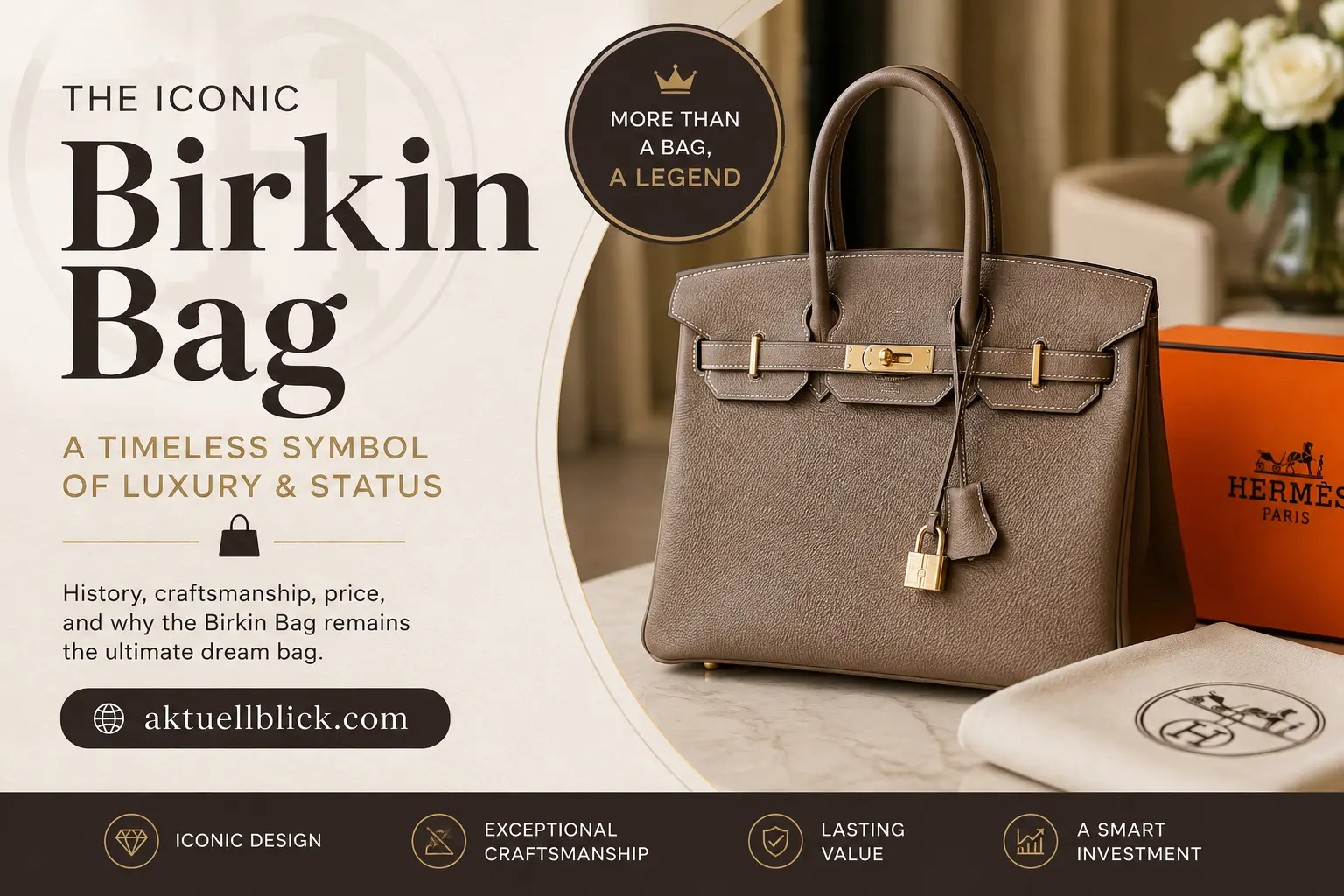

Few luxury accessories carry the same cultural weight, collector demand, and resale attention as the Birkin bag. Created by Hermès in the 1980s, it began as a practical response to Jane Birkin’s need for a roomy everyday handbag, yet it gradually became one of the most recognizable symbols of luxury. Today, buyers encounter everything from classic Togo leather models to rare exotic editions, miniature collector pieces, special orders, and auction examples worth many times their original retail price.
Understanding a Birkin bag can be confusing for a first-time buyer because price alone tells very little. Size, leather, color, hardware, age, condition, construction, rarity, provenance, accessories, and the sales channel can all influence what a particular Hermès Birkin is worth. A smaller model may command more than a larger one, a pre-owned piece may cost more than boutique retail, and two examples that look nearly identical can have very different market values.
This guide explains the subject from the beginning. You will learn where the design came from, why Hermès production is limited, how Birkin sizes differ, which leathers work best for regular use, what retail prices look like in 2026, how the resale market works, how authentication is approached, and what collectors consider before buying or selling.
Most importantly, this guide separates facts from common myths. Boutique availability should not be confused with a guaranteed waiting-list system, resale appreciation should not be treated as guaranteed investment performance, and authentication cannot safely be reduced to checking one stamp or one stitching detail.
What Is a Birkin Bag?
The Hermès Birkin is a top-handle luxury handbag produced by the French house Hermès. Its basic design uses a rectangular body, two rolled handles, a flap, leather straps, a turn-lock closure, a padlock, a clochette for the keys, and protective metal feet called clous. Although countless variations now exist, those recognizable design elements create the classic Birkin silhouette.
Unlike a conventional mass-produced handbag, the Birkin sits at the intersection of functional leatherwork, luxury craftsmanship, scarcity, fashion history, and collecting. Hermès produces it in different sizes, leathers, colors, hardware finishes, constructions, and limited editions. Some versions are intended to be practical everyday pieces, while others are collected primarily because of rarity.
Is every Hermès Birkin extremely expensive? Expensive is relative, but all genuine examples occupy the luxury market. Boutique prices for classic leather versions are far below the prices sometimes reported for rare auction pieces. A standard Togo model should therefore never be compared directly with a diamond Himalaya, Jane Birkin-owned piece, or highly limited Faubourg edition.
The distinction between retail and secondary-market value is essential. Hermès sets boutique prices, but resale prices are determined by supply, demand, condition, desirability, rarity, and seller platform. This is why a highly wanted small neutral example may sell above retail while an older, heavily used larger model can trade much closer to its practical market value.
History of the Hermès Birkin Bag
The story begins in 1984 on a flight from Paris to London. British actress and singer Jane Birkin was seated beside Jean-Louis Dumas, then Executive Chairman of Hermès. She spoke about the difficulty of finding a handbag that was both elegant and practical enough for her needs as a young mother.
Dumas responded by sketching a roomy rectangular holdall. Hermès later developed the concept into the design associated with Jane Birkin’s name. The original idea emphasized usefulness: space, handles, a secure flap, saddle stitching, and enough capacity for everyday belongings.
The first design was much larger than today’s most fashionable compact versions. Jane Birkin herself was associated with a 40-centimeter form, and her personal examples were used rather than preserved like museum pieces. Her bags accumulated stickers, scratches, charms, and visible wear, which is an interesting contrast to the way modern collectors often protect hardware film and maintain pristine condition.
Over subsequent decades, the Hermès Birkin developed into a broader family. New sizes, materials, Sellier constructions, exotic skins, limited editions, special-order combinations, and artistic interpretations appeared without removing the recognizable DNA of the original.
The design’s historical significance became especially clear when Jane Birkin’s original prototype sold at Sotheby’s in July 2025 for approximately $10.1 million, setting a record for a handbag at auction. That price reflected provenance and cultural importance rather than the normal value of a comparable black leather model.
Why the Birkin Bag Is So Famous
Its fame comes from several forces working together rather than from a single marketing feature. First, the connection with Jane Birkin gives the design a memorable origin story linked to fashion, cinema, music, and modern culture.
Second, Hermès already had a long history of high-level leather craftsmanship before the Birkin existed. The house began in 1837 with equestrian craftsmanship, and skills such as saddle stitching remain part of its identity. The handbag therefore inherited an established reputation rather than appearing as an isolated fashion launch.
Scarcity is another major factor. Demand exceeds easy boutique availability, especially for popular combinations. That gap creates curiosity and has helped turn purchasing stories into a topic of their own.
Celebrity visibility also amplified awareness. Actors, musicians, business figures, collectors, stylists, and public personalities have carried different versions over the years. Yet celebrity ownership alone cannot explain decades of demand. The design has remained visually recognizable even as fashion trends changed.
The resale and auction markets added another layer. Once particular editions began selling for substantial premiums, the Hermès Birkin became relevant not just to fashion consumers but also to collectors, auction houses, luxury resellers, and alternative-asset discussions.
Its fame therefore comes from a combination of heritage, design continuity, limited supply, craftsmanship, celebrity visibility, cultural history, and a mature global resale market.
Why the Birkin Bag Is So Expensive
A common assumption is that the price comes only from branding. Brand value certainly matters, but several practical and market factors contribute.
Hermès uses skilled leather artisans and high-grade materials. Construction involves cutting, preparing, stitching, assembling, finishing, and inspecting numerous components. The famous saddle stitch is created by hand using two needles working through the same seam rather than relying on a standard machine stitch.
Published estimates for production time vary. Sotheby’s has described a minimum of roughly 18 hours of handwork, while a 2026 Christie’s specialist guide refers to around 40 hours. Instead of treating either figure as a universal clock for every version, it is more accurate to understand that construction time differs with design, material, complexity, and how individual stages are counted.
Material choice can dramatically increase cost. Classic calfskins such as Togo and Epsom occupy one pricing level, while ostrich, alligator, crocodile, special embroidery, mixed-material construction, precious-metal hardware, or diamonds can move a piece into a completely different category.
Scarcity also matters. Hermès does not supply unlimited quantities simply because demand is high. Limited production and uncertain boutique availability support strong demand on the secondary market.
Finally, buyers are paying for more than raw material and labor. Heritage, craftsmanship, design recognition, service, brand desirability, limited supply, and resale liquidity all contribute to what the market is willing to pay.
Birkin Bag Design and Key Features
The classic silhouette is deceptively simple. A rectangular body provides the base, while two top handles allow hand or forearm carry. The front flap folds over the opening and works with two horizontal sangles, or straps, that meet around the central turn-lock mechanism.
A padlock can secure the closure. Its keys are traditionally stored in a leather clochette that hangs from the handle area. On genuine examples where lock and keys remain together, their identifying numbers should correspond.
Four metal feet, known as clous, protect the base from direct surface contact. Inside, configurations vary somewhat by period and style, but the layout typically includes leather lining and internal pockets.
One design question beginners often ask is: Does the standard Birkin come with a shoulder strap? The classic configuration is primarily a top-handle design. Jane Birkin’s prototype had unique details, and other Hermès variations have appeared over time, but shoppers should not assume a conventional detachable shoulder strap is standard on every model.
Construction also affects appearance. A Retourne version has softer edges and a more relaxed profile because the seams are turned inward. Sellier construction exposes the stitching and produces sharper, more architectural edges.
These seemingly small differences matter because they affect structure, weight, appearance, capacity, wear patterns, and collector preference.
Birkin Bag Sizes and Dimensions
Size names generally refer to width in centimeters. For example, Birkin 25 means approximately 25 centimeters across the base. Dimensions may vary slightly depending on construction and source measurement, but the common reference sizes are useful for comparing capacity.
| Size | Approximate dimensions | General use |
|---|---|---|
| Micro 15 | 15 × 10 × 7 cm | Collector piece, very small essentials |
| 20 | 20 × 16 × 11 cm | Limited/collector-focused compact format |
| 25 | 25 × 20 × 13 cm | Compact daily or evening use |
| 30 | 30 × 22 × 16 cm | Versatile day-to-night option |
| 35 | 35 × 25 × 18 cm | Roomier everyday carry |
| 40 | 40 × 30 × 21 cm | Large carryall or travel-oriented use |
The 25 and 30 dominate current discussions because they fit modern preferences for smaller handbags without losing the recognizable Hermès silhouette. The 35 provides substantially more carrying capacity and often works better for buyers who actually want to use the design as a functional day bag.
A 40 is a much larger object in real life than online photographs suggest. Weight becomes important once leather, hardware, and contents are combined.
Very small versions such as Micro 15 and selected 20-centimeter pieces should not be treated simply as cheaper small sizes. Their rarity can make them significantly more expensive on the collector market.
Most Popular Birkin Bag Sizes in 2026
In 2026, Birkin 25 and Birkin 30 remain the strongest mainstream demand centers in major resale and auction markets.
The Birkin 25 appeals to buyers who prefer a compact silhouette. It looks proportionally small, works well with contemporary fashion, and is highly sought after in neutral colors such as Black, Gold, Etoupe, and selected grey shades. Its limited internal space is the trade-off: it suits essentials better than a large daily load.
The Birkin 30 is often the easiest size to recommend to a first-time buyer who wants both usability and collector relevance. It holds considerably more than a 25 without feeling as large as a 35. Strong demand for the 30 is also reflected in secondary-market activity.
The Birkin 35 has experienced renewed attention as fashion has moved through cycles of small and larger handbags. It provides practical capacity and can sometimes offer better secondary-market value per dollar than the smallest sizes.
The Birkin 40 is more specialized. Travelers and buyers who appreciate oversized proportions may love it, but it generally has a smaller everyday audience.
Which size should a beginner choose? Start with use, not resale hype. If you carry only a phone, cardholder, keys, and a few essentials, consider 25. For a flexible everyday option, 30 is usually easier. For substantial daily capacity, 35 makes more sense.
Birkin Bag Leather Types
Hermès uses a wide range of leathers, and the material can change the same design dramatically.
Togo is one of the best-known options. It is a grained calfskin with a relatively soft hand, visible texture, and good resistance to minor scratching. The material can relax slightly with use without becoming as fluid as some softer leathers.
Epsom has an embossed grain and a firmer, more structured feel. It is relatively lightweight and holds shape well, making it popular with buyers who prefer crisp lines.
Clemence is softer and heavier. It develops a relaxed silhouette more readily and works well for someone who likes a less rigid look.
Swift has a smoother, softer surface and displays color beautifully. The trade-off is that marks may be more visible than on strongly grained leather.
Barenia and Barenia Faubourg are associated with Hermès heritage. Traditional Barenia can develop a pronounced patina, while Barenia Faubourg gives buyers a grained interpretation of that heritage character.
Box calf is smooth, structured, and historically important. It can show scratches, but aging and patina are part of its appeal to experienced collectors.
Exotic materials include ostrich, alligator, and crocodile. These require additional care and may be subject to wildlife-trade regulations when transported internationally.
Best Birkin Bag Leather for Everyday Use
For a practical daily purchase, Togo is difficult to ignore. Its grain helps disguise minor scratches, the leather feels substantial without being excessively rigid, and it develops character with regular handling. For many buyers searching for the best Hermès Birkin leather for everyday use, Togo offers one of the strongest balances between appearance, durability, and ease of ownership.
Epsom is another strong candidate if structure matters more. It tends to retain a crisp silhouette and is comparatively easy to wipe after light surface contact. Because it is embossed, the texture remains visually consistent. The trade-off is a firmer hand that some buyers find less luxurious than natural-grain leather.
Clemence feels soft and rich but is heavier. In larger sizes, that extra weight becomes noticeable even before anything is placed inside.
Swift is excellent for color lovers because saturated shades can look especially vivid, but a buyer worried about every scratch may prefer Togo or Epsom.
Which leather is most durable? There is no indestructible Hermès leather. Togo and Epsom are usually more forgiving for regular handling, but longevity also depends on storage, moisture exposure, overloading, climate, cosmetics, hand oils, and maintenance.
For a first purchase intended for frequent use, choose the material whose aging pattern you can comfortably accept.
Birkin Bag Colors and Popular Choices
Hermès color is a major part of the collecting experience. The house has produced a very broad palette over time, including neutrals, reds, blues, greens, pinks, yellows, purples, browns, whites, and seasonal shades.
Black remains one of the safest choices for a first Hermès Birkin because it works across seasons and wardrobes. Gold is another signature neutral; despite its name, Hermès Gold is a warm tan-brown rather than metallic gold. Etoupe combines grey and taupe tones and is frequently chosen for understated everyday use.
Other desirable neutrals can include Gris Etain, Gris Meyer, Craie, Nata, Beton, and various beige shades, although preferences change with season and leather.
Bright shades have their own collector audience. Rouge H, Rouge Casaque, Rose Sakura, Rose Azalee, Bleu Electric, Bleu Jean, Vert Vertigo, and many other colors have attracted strong followings at different times.
Color names alone do not determine value. A shade may look very different in Togo, Epsom, Swift, ostrich, or crocodile because texture and light reflection change the result.
What color is easiest to resell? Broadly wearable neutrals tend to have deeper buyer pools, but rare seasonal colors and highly desirable pinks, blues, or greens can outperform in the right configuration.
Most Valuable Birkin Bag Colors
There is no permanent ranking in which one color always has the highest resale value. Value is created by the combination of shade, size, leather, hardware, condition, year, rarity, and current buyer preference.
Black is consistently liquid because it attracts buyers across different tastes. Gold and Etoupe also remain core collector neutrals. These colors are relatively easy to understand and style, which expands their potential buyer base.
Rare discontinued shades can behave differently. A color that appears infrequently and develops collector demand may achieve a meaningful premium, especially in smaller sizes. Highly desirable pinks, greens, blues, and whites can become difficult to source.
Himalaya is a separate case. The famous grey-to-white gradation found on rare crocodile examples is not simply a standard solid color. Its production, material, scarcity, and association with high-level collecting place it in a different price tier.
Condition still matters. A desirable color with discoloration, corner wear, handle darkening, staining, or restoration may sell below a less fashionable color in pristine condition.
Buyers should therefore avoid choosing solely from a social-media list of “best resale colors.” If long-term liquidity matters, prioritize an attractive combination of recognized shade, useful size, strong condition, and broadly desirable leather.
Birkin Bag Hardware Options
Hardware can change the overall character of a Hermès Birkin even when leather and color remain the same.
Gold hardware, usually abbreviated GHW in resale listings, creates a warm appearance and is especially popular with Black, Gold, Etoupe, Rouge H, and many brown or neutral leathers.
Palladium hardware, abbreviated PHW, has a cool silver-toned finish and gives the design a cleaner, more contemporary appearance. It pairs naturally with greys, blues, whites, blacks, and cool-toned colors, although there are no strict styling rules.
Hermès has also produced less-common finishes including permabrass, brushed palladium, brushed gold, rose-gold-toned hardware, ruthenium, and special treatments on selected editions.
At the top end, certain exotic pieces have been produced with precious-metal and diamond hardware. Those should not be compared with ordinary plated hardware because they belong to a much narrower collector category.
Does hardware determine resale value? Usually not by itself. It can strengthen or weaken the desirability of a specific color combination, but size, condition, leather, rarity, year, and overall configuration tend to carry more weight.
When buying for personal use, jewelry preference provides a simple starting point: people who regularly wear warm gold jewelry may prefer GHW, while silver, platinum, or white-gold wearers may naturally gravitate toward PHW.
Hermès Birkin Bag Price in 2026
Current 2026 retail pricing shows how far the classic leather range has moved. Reported U.S. boutique prices for Togo include approximately $13,500 for a Birkin 25, $14,900 for a Birkin 30, $16,300 for a Birkin 35, and $20,300 for a Birkin 40.
European pricing is lower before considering travel costs, taxes, currency movements, and actual availability. Reported 2026 European prices include approximately €9,600 for a Togo 25, €10,600 for a Togo 30, and €11,600 for a Togo 35.
These figures should be treated as reference prices rather than a promise that a particular configuration will be available. Different leather, exotic material, limited-edition construction, embroidery, mixed media, or special detailing can materially increase retail cost.
For example, reported U.S. 2026 pricing for selected Birkin 25 versions ranges from the classic Togo level to substantially higher amounts for Cargo, Picnic, Rock, matte alligator, and shiny Porosus crocodile examples.
Another important point is that Hermès prices can change. Currency movements can also alter international comparisons.
A first-time buyer should therefore separate three questions: What is the current boutique retail price? What is actually available to purchase? What would the equivalent configuration cost on the secondary market? Those answers are often very different.
Birkin Bag Price by Size
Size influences retail price, but secondary-market pricing does not rise in a simple straight line as a model becomes larger.
For classic 2026 U.S. Togo references:
| Model | Reported U.S. retail |
|---|---|
| Birkin 25 Togo | $13,500 |
| Birkin 30 Togo | $14,900 |
| Birkin 35 Togo | $16,300 |
| Birkin 40 Togo | $20,300 |
At retail, larger sizes generally cost more because they require more material and construction work. The resale market can reverse that logic. A Birkin 25 may command a higher percentage premium than a larger model because demand for compact sizes is currently stronger.
Sotheby’s reported that a classic Togo Birkin 30 averaged roughly $22,300 in its 2025 sales data, showing how a desirable configuration can sit materially above boutique retail.
Very small limited versions are even less predictable. A 20-centimeter Faubourg or rare exotic Micro 15 is not priced as simply “less material than a 25.” Scarcity and collectability dominate the equation.
For shoppers comparing Birkin prices by size, retail cost should therefore be only the first column. Add expected resale range, carrying capacity, weight, market liquidity, condition sensitivity, and actual personal use before choosing.
Retail vs Resale Birkin Bag Prices
The unusual relationship between boutique and secondary-market pricing is one of the most important things a new buyer needs to understand.
At an Hermès boutique, a classic leather version may have a lower official price than the same desirable configuration available immediately from a reputable reseller. The resale buyer is effectively paying for immediate access, exact choice, and relief from uncertain boutique inventory.
That premium is not universal. Older, heavily used, larger, less-fashionable, or less-desired combinations may trade much closer to retail or below the current retail price of a new equivalent.
Condition creates another major divide. Store-fresh pieces with full packaging, clean interiors, unworn corners, and intact protective film on hardware often receive the strongest asking prices. Excellent used examples follow, while visible wear, staining, odor, structural loss, or questionable restoration can reduce value.
Resale listings and actual sale prices must also be separated. A seller can ask any amount; completed transactions are better indicators of what buyers actually pay.
Why would anyone pay above retail? Because the secondary market can offer a specific size, leather, color, hardware combination, and year immediately. At the boutique, the buyer may not be offered that exact configuration at all.
Factors That Affect Birkin Bag Value
No serious valuation should be based on one characteristic. Professional buyers examine the entire configuration.
The most important factors include:
- Size: 25 and 30 currently have broad demand.
- Leather or skin: Togo, Epsom, Box, Barenia, ostrich, crocodile, and alligator behave differently.
- Color: neutrals provide liquidity while rare colors can generate collector premiums.
- Condition: corner wear, scratches, handle darkening, interior stains, odor, and structural changes matter.
- Age and stamp: newer pieces often receive premiums when everything else is equal.
- Hardware: usually secondary to size, material, and condition, but the right pairing can improve demand.
- Rarity: limited editions and unusual combinations can sell far above classic models.
- Construction: selected Sellier versions may attract extra collector interest.
- Accessories: box, dust bag, clochette, lock, keys, felt, receipt, rain cover, and other original items can improve completeness.
- Provenance: historically important ownership can transform value.
- Market timing: fashion cycles influence demand for sizes and colors.
A Jane Birkin-owned example illustrates why provenance must be treated separately. Its value is not a useful benchmark for an ordinary vintage Black Box model.
For everyday valuations, comparable recent sales of genuinely similar examples are much more informative than record-setting auction headlines.
Birkin Bag Resale Market Trends in 2026
The 2026 market continues to show strong demand, particularly around smaller classic models and rare collector editions.
Sotheby’s reported that its overall Birkin sales increased by more than 70% in 2025 compared with 2024 and were approximately 95% above 2023 levels. Since 2021, the auction house has handled close to $100 million in Birkin sales, indicating that the category has developed substantial secondary-market depth.
The strongest mainstream liquidity continues to center around Birkin 25 and Birkin 30 examples, especially in good condition and wearable colors. Neutral Togo combinations remain easy for many buyers to understand, which supports broad demand.
Larger models offer a different opportunity. Buyers interested in actual daily capacity may find a 35 comparatively attractive because small-model premiums can distort price-per-use.
Limited editions behave differently from classics. Newly released rare pieces may experience intense early premiums, followed by normalization as initial scarcity becomes better understood. Exceptional discontinued designs can later strengthen again if collector demand grows.
The key 2026 trend is therefore not “everything goes up.” The market is increasingly segmented. Small neutrals, top-condition pieces, special orders, rare editions, desirable exotics, and documented provenance can perform very differently from common or heavily worn configurations.
Birkin Bag as an Investment
Calling any luxury handbag an investment requires caution.
Hermès resale performance has been strong for many desirable models, and certain examples have appreciated substantially. However, that does not mean every purchase will generate a profit.
A buyer must consider acquisition price, reseller markup, auction buyer’s premium, seller commission, authentication costs, insurance, shipping, taxes, storage, repairs, and the time required to find a buyer. These costs can materially reduce apparent gains.
Liquidity is another issue. A Black Togo Birkin 25 in excellent condition may attract a large audience, while an expensive exotic 40 in an unusual color could take much longer to sell.
Condition also makes handbag investing different from owning a financial security. Regular use can create scratches, corner wear, handle discoloration, shape loss, interior marks, and hardware wear. Preserving value may therefore conflict with enjoying the object.
Can a Hermès Birkin increase in value? Yes, selected examples clearly have. Is appreciation guaranteed? No.
Someone buying primarily for return potential should think like a collector: study rarity, documented transactions, condition, configuration, provenance, supply, and exit costs. Someone buying primarily for enjoyment should choose a model they genuinely want to use instead of relying on future appreciation.
Most Valuable Birkin Bags for Collectors
Collector value tends to concentrate where rarity, craftsmanship, condition, historical importance, and desirability overlap.
Diamond Himalaya examples occupy the upper end of conventional collecting. Their exotic skins use a distinctive gradation associated with Himalayan snow, while selected versions include 18-karat white-gold and diamond hardware.
The Faubourg family has become another major collector category. These designs reinterpret the façade of Hermès’ historic Paris flagship through elaborate combinations of leather, exotic material, color, structure, and architectural detailing.
Horseshoe Stamp special orders, commonly called HSS, can be highly desirable when their customized color and hardware combinations appeal to buyers. The horseshoe indicates a special-order origin rather than automatically guaranteeing a specific premium.
Older rare materials, discontinued colors, unusual sizes, early examples, metallic finishes, So Black designs, Picnic versions, Cargo editions, Shadow models, and artistically complex pieces can all attract collector demand.
Condition and completeness remain crucial even at the high end.
Provenance can exceed every conventional value factor. Jane Birkin’s original prototype reached approximately $10.1 million because collectors were buying an object tied directly to the creation story of the design. That figure should be understood as cultural-artifact pricing rather than a comparable market price for ordinary inventory.
Rare and Limited-Edition Birkin Bags
Rare Hermès models go far beyond unusual colors.
The Himalaya is recognized for a carefully graded grey-and-white exotic finish. It is associated with some of the highest handbag auction results, particularly when paired with diamond hardware.
The Faubourg Birkin 20 is inspired by the Hermès flagship at 24 Rue du Faubourg Saint-Honoré in Paris. Its front resembles a miniature storefront, complete with architectural details. Versions such as Day, Night, Snow, Midnight, and Rainy Days have attracted intense collector attention.
The Picnic combines leather with woven material, giving a basket-like interpretation of the traditional design.
The Cargo introduces utilitarian exterior pockets and mixed materials, transforming the usually clean façade into something more functional and visually technical.
The Shadow uses trompe-l’œil effects to suggest familiar straps and details through embossed construction.
The So Black aesthetic uses black leather combined with dark hardware, creating a monochromatic appearance prized by some collectors.
Special-order HSS pieces add another form of rarity because their combinations may not exist in normal production.
Rarity alone, however, is not sufficient. A rare design must also attract buyers. The strongest values usually occur when low supply is combined with recognizable design significance and sustained collector demand.
Most Expensive Birkin Bags Ever Sold
The most important record belongs to Jane Birkin’s original prototype. In July 2025, the black Box calf example created in connection with Jane Birkin and Jean-Louis Dumas sold at Sotheby’s for approximately $10.1 million, establishing a world auction record for a handbag.
That result should not be used to estimate ordinary vintage pieces. The prototype is historically unique because it is tied directly to the origin of one of fashion’s most recognizable designs.
Other extraordinary auction prices come from rare Himalaya, diamond, and limited-edition examples.
The collector market remained active in 2026. Christie’s reported a rare Snow Faubourg example selling for HK$4.318 million in May 2026, while a limited-edition Rouge Faubourg reached €635,000 in June 2026.
These transactions demonstrate how far the high-end collector market has separated from normal retail buying.
For context, a conventional leather Birkin 25 or 30 trades in the tens of thousands of dollars rather than millions. Even many exotic pieces remain far below record-setting cultural or limited-edition examples.
When reading “most expensive Hermès handbag” lists, always check whether the number represents an asking price, auction estimate, hammer price, price including buyer’s premium, private sale, or verified completed transaction. Those categories are not interchangeable.
How to Buy a Birkin Bag in 2026
There are two main routes: purchase through Hermès or buy through the secondary market.
Hermès states that Birkin, Kelly, and Constance handbags are sold through its stores rather than the normal online e-commerce selection. Availability varies by boutique, and the company recommends discussing availability with a local store and making an appointment where available.
A common online narrative says there is a universal formula involving a precise amount of “pre-spend.” Hermès does not publish such a formula in its official availability guidance. Client relationships and local boutique practices are widely discussed by shoppers, but those experiences should not be presented as a guaranteed global rule.
The secondary market is more straightforward in one sense: buyers can search for the exact size, leather, color, year, and hardware they want. The trade-off is that desirable examples often carry a premium.
Before purchasing pre-owned, compare several genuinely similar examples. Check seller reputation, authentication process, return conditions, detailed photographs, condition description, accessories, restoration disclosure, and final all-in cost.
For exotics, investigate import and export restrictions before purchasing internationally.
The safest purchasing strategy is not simply finding the lowest price. It is minimizing uncertainty around authenticity, condition, legal transport, and true market value.
Buying a Birkin Bag Directly From Hermès
Buying directly from Hermès offers the clearest authenticity chain because the item comes from the brand itself.
Hermès’ current U.S. guidance states that Birkin, Kelly, and Constance models are sold exclusively in its stores. Each store determines its assortment, and availability can change. That means a buyer cannot assume that visiting a boutique will produce a specific size or color.
A sensible process is:
- Identify the sizes, colors, leathers, and hardware combinations you would genuinely accept.
- Visit or contact the relevant boutique according to local appointment practices.
- Explain preferences clearly rather than presenting an impossibly narrow specification unless you are willing to wait.
- Evaluate an offered piece based on use and personal preference, not just the fear that another opportunity will never appear.
- Keep the original invoice and packaging carefully.
There is no universally reliable public “waiting-list position” that tells every customer when a particular configuration will become available.
Another mistake is buying unrelated products solely because social media says they guarantee access. Customer experiences vary, but a guaranteed transaction formula should not be treated as official policy.
If boutique access is your goal, approach the process as luxury retail rather than a puzzle to manipulate.
For the latest updates and insights, explore Angela Bassett today.
New vs Pre-Owned Birkin Bag
New and pre-owned purchases solve different problems.
A new boutique purchase provides direct provenance, current retail pricing, untouched condition, and the full brand experience. The disadvantage is limited control over what is available.
A pre-owned Hermès Birkin gives you much greater choice. You can search by exact size, leather, shade, hardware, year, condition, or discontinued specification. This can be particularly useful for vintage Box leather, discontinued colors, older 35 and 40 models, special orders, and limited editions.
Pre-owned does not automatically mean inexpensive. A pristine Birkin 25 in a highly desired neutral may cost considerably more than boutique retail because the buyer is paying for immediate availability.
Conversely, visible wear can create value opportunities for people who want to use the handbag without worrying about every mark.
Ask yourself three questions:
- Do I care more about boutique experience or exact specification?
- Do I want pristine condition or am I comfortable with honest wear?
- Am I willing to pay a secondary-market premium for immediate access?
For many practical buyers, an authenticated excellent-condition pre-owned model can make more sense than chasing a perfect boutique offer.
Where to Buy an Authentic Birkin Bag
The strongest authenticity certainty comes from purchasing directly through an official Hermès point of sale. Hermès itself states that it cannot guarantee or verify items purchased outside its official distribution network.
On the secondary market, the goal changes from “official guarantee” to “reduce risk through layered verification.”
Established auction houses and specialist luxury resellers generally provide authentication systems, condition reporting, and transaction histories. However, buyers should still understand exactly what a seller promises. “Authenticated,” “verified,” “entrupy checked,” “expert reviewed,” “lifetime authenticity guarantee,” and “final sale” can mean different things depending on the company.
A trustworthy listing should ideally provide clear photographs of:
- front, back, sides, base, and interior;
- handles and corners;
- blind/date stamp where appropriate;
- logo stamp;
- stitching;
- hardware engravings;
- lock, keys, and clochette;
- interior lining and pockets;
- accessories and packaging;
- scratches, stains, repairs, or restoration.
Avoid purchasing solely because a listing includes a receipt, box, or authentication card. Packaging and paperwork can also be copied or separated from original goods.
Price is another warning signal. A supposedly pristine current-model Hermès Birkin offered far below established market ranges deserves much deeper investigation.
How to Authenticate a Birkin Bag
Authentication is a multi-factor examination, not a one-step checklist.
Experts assess material, construction, proportions, stitching, stamping, hardware, engravings, interior details, age consistency, and the relationship between all of those elements.
The saddle stitching used by Hermès has a characteristic hand-worked appearance. It should not look like uniform mass-production stitching. However, handmade construction also means slight variation can occur, so perfection itself is not the test.
Hardware engravings should be crisp and appropriately finished. A lock and its corresponding keys should have matching numbers when they belong together. The clochette should feel properly constructed rather than thin or loosely shaped.
The blind stamp can help determine whether the period is consistent with the model. Hermès stamping formats have changed over the years, and some authentic pieces do not fit simplistic internet charts. Therefore, a stamp alone cannot establish authenticity.
Exotic materials may carry additional markings associated with species.
Shape, leather behavior, handle construction, feet, zipper details, lining, and craftsmanship must also make sense as a whole.
Can you authenticate a Hermès Birkin from one photograph? Reliably, no. High-quality authentication requires multiple details, and difficult cases should be assessed by an experienced specialist.
Real vs Fake Birkin Bag
Counterfeits range from obvious replicas to sophisticated examples made with high-quality leather and copied packaging. This is why beginner guides that promise one “secret sign” are dangerous.
A fake may fail in several areas:
- incorrect overall proportions;
- machine-like or inconsistent stitching;
- poorly shaped handles;
- wrong leather texture;
- inaccurate logo typography;
- overly deep or incorrect blind stamps;
- lightweight or poorly finished hardware;
- blurred engravings;
- incorrect lock and key construction;
- mismatched interior materials;
- weak edge finishing;
- incorrect feet;
- inaccurate zipper components;
- suspicious accessories or packaging.
At the same time, an authentic vintage example may have scratches, softened structure, worn hardware, replacement components, or natural irregularities. Age is not proof of being counterfeit.
A common mistake is believing that authentic Hermès must always look perfectly symmetrical and untouched. Handmade leather goods change over time.
Another mistake is believing a receipt proves authenticity. Documentation supports provenance only when the entire transaction trail is trustworthy.
For a high-value purchase, treat online visual checks as preliminary screening. A professional examination and a seller with a meaningful authenticity guarantee provide far stronger protection.
Birkin Bag Stamp, Stitching, Hardware, and Craftsmanship
The blind stamp is one of the most discussed details in Hermès authentication. It can indicate production era and workshop-related information, but formats have changed across decades. Older systems used letters associated with shapes; later examples use different coding conventions. The stamp should be evaluated in historical context rather than through a single universal chart.
Stitching is equally important. Hermès is associated with the saddle stitch, which uses two needles working through the same holes. The result has a characteristic slight angle rather than the mechanical appearance of standard machine sewing.
Hardware deserves close inspection. Engravings should be precise, edges should feel properly finished, and plating should be consistent with normal wear for the age of the piece. Christie’s specialists note that significant peeling or flaking can be concerning.
The clochette is another useful detail. It should be made and shaped correctly, with the lock and keys corresponding when original components remain together.
Craftsmanship must be judged as a system. No genuine authentication process should declare an expensive item authentic solely because the stamp looks right.
The best experts ask whether the leather, stitching, stamp, structure, hardware, dimensions, interior, age, and known Hermès production practices all tell the same story.
Vintage vs New Birkin Bag
A vintage Hermès Birkin can offer character that a store-fresh piece simply does not have.
Older Box calf models, for example, often develop visible scratches and a distinctive patina. For collectors who appreciate aged leather, those marks become part of the object’s story rather than defects that must be hidden.
Vintage pieces can also provide access to discontinued colors, older hardware combinations, less-common materials, and configurations that are difficult to find today.
A new model offers different advantages: current construction, pristine leather, contemporary colors, complete packaging, and easier condition assessment. Newer pieces often receive stronger resale pricing when compared with otherwise similar older examples.
The correct choice depends on the buyer.
Choose vintage if you value:
- patina and character;
- discontinued colors or materials;
- historical interest;
- potentially lower prices on some larger classic models.
Choose new or near-new if you value:
- pristine condition;
- modern color availability;
- full packaging;
- easier resale comparison;
- minimal restoration concerns.
Do not judge age alone. A beautifully preserved 20-year-old example can be more desirable than a recent piece with poor storage, odor, staining, or careless restoration.
Birkin Bag vs Kelly Bag
The Birkin and Kelly share Hermès craftsmanship, premium materials, and collector prestige, but their designs serve different purposes.
The Birkin has two handles and a more relaxed open-top carrying style when the straps are left undone. This makes access easier for everyday use.
The Kelly traditionally has one top handle and a more formal trapezoidal silhouette. Modern versions commonly include a detachable shoulder strap, giving it greater hands-free versatility.
The Kelly also has a longer history. Its origins trace back to the Sac à Dépêches of the 1930s, and its association with Grace Kelly preceded the creation of the Birkin.
Construction choices differ as well. Kelly Sellier and Retourne are foundational distinctions, while Sellier versions of the Birkin are comparatively more specialized.
Which is easier for everyday use? That depends on lifestyle. Someone who constantly reaches into a handbag may prefer the Birkin’s open, double-handle practicality. Someone who wants a shoulder strap and a more formal profile may prefer the Kelly.
From a resale perspective, both have highly desirable sizes and rare versions. Neither is automatically “better.” Buyers should compare carrying method, capacity, closure habits, size, leather, and personal wardrobe before choosing.
How to Choose the Right Birkin Bag
The easiest way to make a poor luxury purchase is to begin with resale rankings instead of your real needs.
Start with size. Place the objects you carry every day on a table: phone, wallet, keys, cosmetics, glasses, notebook, chargers, and anything else. That immediately tells you whether 25 is realistic or whether 30 or 35 would be more comfortable.
Then consider weight. A large Clemence model filled with daily items can become heavy. If weight matters, smaller sizes or structured lighter leathers deserve more attention.
Next choose your tolerance for wear. Someone who dislikes visible scratches may be happier with Togo or Epsom than smooth Box or Swift.
Color should match your actual wardrobe. Black, Gold, Etoupe, and grey shades are versatile, but buying a neutral only because it is considered “safe” makes little sense if you really want a vivid blue or green.
Hardware follows naturally from the palette and your jewelry.
Finally, decide whether you are buying to use, collect, or resell later. Those goals can lead to different choices.
A simple first-purchase formula is: useful size + durable leather + color you regularly wear + strong condition + trustworthy provenance. Rarity should come after those basics unless collecting is the primary objective.
How to Care for a Birkin Bag
Hermès leather changes naturally over time. The goal of care is not to freeze the handbag in new condition but to prevent avoidable damage.
Protect it from prolonged moisture, intense heat, direct sunlight, and uncontrolled humidity. Water can affect different leathers in different ways, while long exposure to light can alter color.
Avoid applying generic leather conditioner, waterproof spray, wipes, perfume, or cleaning chemicals without understanding how the specific material reacts. Hermès advises against ordinary care products that are not adapted to its leathers.
Handle cosmetics carefully. Makeup, hand cream, sanitizer, oils, and ink can stain interiors or handles.
Do not overload the handbag. Excessive weight can stretch handles, distort the base, and change the silhouette.
Hardware will naturally develop hairline scratches with use. Protective stickers can preserve the finish when new, but owners should decide whether they are preserving for collecting or actually using the piece.
For significant cleaning or repair, Hermès offers workshop assessment through its boutiques. Repairs are evaluated individually, with an estimate and expected service period provided after examination.
Good care is simple: clean hands, sensible storage, moderate loading, controlled environment, and professional intervention when necessary.
How to Store a Birkin Bag Properly
Poor storage can damage an expensive handbag even when it is rarely used.
Empty the interior before storing it. Pens, cosmetics, receipts, food, and liquids should never remain inside for long periods.
Support the shape gently with clean, acid-free tissue or an appropriate soft insert. Do not overstuff it, because forcing the sides outward can distort the structure.
Place the item inside its breathable dust bag. Avoid sealing leather for long periods in airtight plastic, where humidity can become trapped.
Store it upright in a cool, dry area away from direct sunlight, radiators, vents, and extreme temperature changes. Shelves should provide enough room so handles and sides are not compressed by other items.
The flap and straps should rest naturally rather than being aggressively tightened if that creates pressure marks. Hardware can be protected from unnecessary contact with leather surfaces.
For very long-term storage, inspect the piece periodically. Check for humidity, odor, mold, shape changes, and unwanted material transfer.
Exotic skins require extra care, particularly around moisture and international transport documentation.
The objective is not to make storage complicated. Leather benefits from a stable environment, support without pressure, breathable protection, and occasional inspection.
How to Sell a Birkin Bag
Selling successfully begins before the item is listed.
First identify the exact model: size, leather, official color if known, hardware, year or stamp, construction, and special-edition status. If any detail is uncertain, do not guess.
Next assess condition realistically. Photograph corners, handles, hardware, feet, interior, base, structure, stitching, stamps, and every visible flaw. Buyers pay more confidently when condition disclosure is clear.
Gather original accessories such as the box, dust bag, felt, clochette, lock, keys, care materials, rain cover, receipt, and ribbon where available.
Then obtain more than one valuation. Different marketplaces serve different buyers and may produce different net outcomes.
Selling routes include:
- fixed-price luxury resale;
- consignment;
- auction;
- dealer purchase;
- private sale.
A fixed-price marketplace can provide more predictable pricing. Auction may create competition for rare pieces but also involves uncertainty and fees.
Before accepting an offer, calculate net proceeds, not headline sale price. Commission, insurance, shipping, authentication, payment processing, and taxes may affect what you actually receive.
For common leather models, recent comparable sales usually provide the best valuation basis. Rare Faubourg, Himalaya, HSS, historical, or celebrity-provenance examples may deserve specialist auction review.
How to Determine Birkin Bag Resale Value
Begin with precise identification. “Black Hermès handbag” is not enough. A proper valuation might read more like: Birkin 25, Black Togo, gold hardware, specific production year, excellent condition, complete accessories.
Then locate recent sales with the closest possible configuration.
Compare:
- Size – do not compare 25 directly with 35.
- Material – Togo and exotic crocodile belong to different markets.
- Color – neutral demand can differ from seasonal shades.
- Hardware – match it where possible.
- Year – recent examples may receive premiums.
- Condition – pristine and heavily used inventory cannot be valued together.
- Accessories – completeness affects buyer confidence.
- Selling channel – auction, dealer, consignment, and private sale produce different net values.
Asking prices should be used carefully. A listing that has remained unsold for eight months may represent seller ambition rather than market value.
Professional valuation is especially useful for rare limited editions and exotics.
A useful practical formula is:
Estimated market value = comparable completed sales adjusted for condition, rarity, age, configuration, and selling costs.
No automated calculator can perfectly capture every factor, but a disciplined comparable-sales method is far more reliable than assuming a fixed percentage increase from original retail.
Birkin Bag Market and Collector Trends in 2026
The 2026 collector market shows several distinct trends.
First, smaller sizes remain powerful. Birkin 25 continues to receive substantial attention, while 30 retains strong demand because it combines practical capacity with contemporary proportions.
Second, retail prices increased again in 2026. Reported U.S. increases pushed classic Togo models to $13,500 for 25, $14,900 for 30, and $16,300 for 35. European increases also moved the same configurations higher.
Third, the market is becoming more sophisticated. Serious buyers increasingly differentiate between retail price, reseller asking price, auction estimate, hammer result, and final price including premiums.
Fourth, limited editions remain a separate collector ecosystem. Faubourg, Himalaya, Picnic, Cargo, Shadow, So Black, and HSS examples can behave very differently from standard leather inventory.
Fifth, provenance has become impossible to ignore after the record-setting sales of Jane Birkin’s personal pieces.
Finally, larger sizes should not be dismissed. The fashion cycle has started giving larger handbags more cultural attention again, and buyers who prioritize function may find 35 and 40 more attractive than during the peak mini-bag period.
The broad lesson for 2026 is segmentation. There is no single “Birkin market.” Classic daily pieces, vintage inventory, small neutrals, exotics, limited editions, and museum-level provenance operate at very different price points.
FAQs
How much does a Hermès Birkin cost in 2026?
For classic Togo models in the United States, reported 2026 retail references are approximately $13,500 for a 25, $14,900 for a 30, $16,300 for a 35, and $20,300 for a 40. Different materials and limited editions can cost considerably more. Secondary-market prices may also exceed retail for desirable combinations.
What is the most popular Birkin size?
The 25 and 30 are currently the most broadly sought-after sizes. The 25 appeals to buyers who want compact proportions, while the 30 provides a stronger balance between capacity and contemporary styling.
Which Birkin size is best for a first-time buyer?
For many buyers, 30 is the easiest all-around choice because it is large enough for everyday essentials without feeling oversized. A minimalist may prefer 25, while someone who carries more items should consider 35.
Which Hermès leather is best for everyday use?
Togo is one of the most practical choices because its grain helps disguise minor marks and it offers a good balance of softness and durability. Epsom is also practical for buyers who prefer lightweight structure.
Is Togo better than Epsom?
Neither is universally better. Togo feels softer and more natural, while Epsom is firmer, lighter, and more structured. Choose according to how you want the handbag to age and feel.
Why are Birkins difficult to buy from Hermès?
Demand is high and boutique availability is limited. Hermès confirms that Birkin, Kelly, and Constance models are sold through its stores, with inventory varying by location. There is no official guarantee that a customer visiting a boutique will receive a particular configuration.
Is there an official Birkin waiting list?
Hermès does not publish a universal numbered waiting-list system in its current availability guidance. Boutique practices and customer experiences can vary by location.
Do you need to spend money on other Hermès products first?
Many customers discuss purchase history and boutique relationships, but Hermès does not publicly publish a universal spending threshold that guarantees a Birkin offer. Treat any exact “spend this amount and receive this model” formula with caution.
Can you buy a Birkin online from Hermès?
Hermès’ current U.S. guidance states that Birkin, Kelly, and Constance handbags are sold exclusively in Hermès stores rather than through the normal online leather-goods selection.
Is a pre-owned Hermès Birkin cheaper?
Not necessarily. Highly desirable recent models can sell above boutique retail because they are immediately available. Older, larger, heavily used, or less-demanded combinations may cost less than pristine small models.
What colors have the strongest resale demand?
Black, Gold, Etoupe, and other versatile neutrals generally have broad buyer pools. Rare seasonal colors can also command premiums when collector demand is strong.
What is Hermès Gold?
Gold is the name of a classic warm tan-brown Hermès color. It does not mean metallic-gold leather.
What is the rarest Birkin?
There is no single answer because rarity can refer to production quantity, material, provenance, or edition. Himalaya, Faubourg, rare HSS combinations, diamond versions, historical prototypes, and certain discontinued designs all occupy highly collectible categories.
What is a Himalaya Birkin?
It is an exotic Hermès version known for a carefully graded grey-to-white finish reminiscent of Himalayan mountains. Selected diamond-hardware examples have achieved exceptional auction values.
What does HSS mean?
HSS is commonly used by collectors for Horseshoe Stamp special orders. These pieces are customized through Hermès and carry a small horseshoe marking near the brand stamp.
What is Sellier construction?
Sellier construction places the seams outward, creating sharper edges and a more structured silhouette. Retourne construction turns seams inward and generally produces softer, rounder edges.
Is a Birkin a good investment?
Some examples have appreciated substantially, but returns are not guaranteed. Condition, purchase price, rarity, market demand, fees, insurance, taxes, and resale commission all affect actual performance.
Do all Birkins increase in value?
No. Some desirable configurations appreciate, others remain relatively stable, and some may sell below an owner’s acquisition cost after fees. Luxury resale should never be treated as guaranteed financial return.
What affects resale value the most?
Condition, size, leather, color, rarity, age, configuration, accessories, and current demand are major factors. For historically significant pieces, provenance can outweigh almost everything else.
How can I tell whether a Hermès Birkin is authentic?
Authentication requires examination of multiple features, including proportions, leather, stitching, stamping, hardware, engravings, construction, interior details, age consistency, lock, keys, and clochette. No single feature proves authenticity.
Does a date stamp prove authenticity?
No. Counterfeiters can copy stamps. The stamp is one element that must make sense together with construction, material, hardware, and production era.
Should stitching on an authentic Hermès piece be perfectly straight?
Hand saddle stitching has a characteristic appearance and may show subtle human variation. Artificial machine-like uniformity is not a requirement for authenticity.
Do lock and key numbers match?
When the original corresponding lock and keys remain together, the numbers should match. Replacement or separated accessories can complicate assessment, especially with older examples.
Can Hermès authenticate a pre-owned purchase?
Hermès states that it cannot guarantee or verify the authenticity of items purchased outside its official points of sale. Buyers using the secondary market should rely on reputable specialist authentication and strong seller guarantees.
Can Hermès repair an older handbag?
Hermès workshops handle many repair and refurbishment requests. A boutique can examine the item and provide an estimate and expected service period based on the work required.
Should I use leather conditioner at home?
Avoid random commercial conditioners, waterproofing sprays, wipes, or cleaning chemicals. Hermès advises against products that are not specifically adapted to its leathers.
What is the best way to store one?
Empty it, support the shape gently, use a breathable dust bag, avoid direct sunlight and extreme heat, maintain a dry stable environment, and do not compress the handles or sides.
What is the most expensive Birkin ever sold?
Jane Birkin’s original prototype sold at Sotheby’s in July 2025 for approximately $10.1 million, setting a world auction record for a handbag. Its extraordinary value came from unique historical provenance.
Why can resale prices be higher than retail?
A secondary-market buyer can choose an exact model and purchase it immediately. That certainty can create a premium when boutique availability is limited, particularly for small sizes, desirable neutrals, rare colors, and pristine examples.
Is Birkin 25 better than Birkin 30?
The 25 is more compact and currently highly sought after, while the 30 is more practical for everyday capacity. The better choice depends on what you carry and how you plan to use it.
Is Birkin 35 still popular in 2026?
Yes. Although 25 and 30 dominate current collector demand, the 35 remains an important classic and has practical advantages for buyers who want more capacity. Renewed interest in larger handbags also supports its relevance.
Should I choose gold or palladium hardware?
Choose according to the leather color, your jewelry, and personal taste. Gold gives a warmer appearance, while palladium creates a cooler silver-toned look. Hardware alone rarely determines overall market value.
Is vintage better than new?
Vintage provides patina, history, discontinued materials, and sometimes better pricing. New provides pristine condition, modern colors, and easier condition comparison. Neither category is automatically superior.
What should I check before buying pre-owned?
Confirm exact size, material, color, hardware, production period, condition, authentication method, seller reputation, return policy, included accessories, restoration history, shipping terms, and total cost.
Are exotic versions harder to travel with?
They can be. Crocodile, alligator, and other regulated materials may require documentation or face import restrictions depending on the countries involved. International buyers should check applicable wildlife and customs rules before purchasing or traveling.
Conclusion
The Hermès Birkin remains unusual because it can be understood in several completely different ways at once. It is a functional top-handle design, an example of French leather craftsmanship, a cultural object connected to Jane Birkin and Jean-Louis Dumas, a status symbol, a resale-market category, and—in its rarest forms—a serious collector piece.
For a first-time buyer, the subject becomes much easier once the hype is separated from the practical decisions. Start with size, then leather, color, hardware, condition, and purchasing channel. A Birkin 25 may offer maximum current demand, but a 30 could be more useful. Togo may suit frequent wear, while Epsom may suit someone who values structure. Black might offer broad resale liquidity, but a distinctive color may provide far more personal enjoyment.
Price also needs context. Boutique retail, secondary-market asking prices, completed sales, auction records, and historically important pieces represent different markets. A record-breaking multimillion-dollar prototype says little about what an ordinary leather model should cost.
Authentication deserves the same disciplined approach. Stamps, stitches, locks, engravings, leather, proportions, and hardware should be examined together, not as isolated “real or fake” tricks.
In 2026, the smartest buyer is therefore not simply the person who can obtain the rarest model. It is the person who understands what they are purchasing, why a particular configuration has value, how it fits their lifestyle, what risks exist in the secondary market, and how to care for the piece after acquisition.
Whether the goal is everyday use, a first Hermès purchase, long-term collecting, resale, or simply understanding why this design became so important, those fundamentals provide the clearest path through one of luxury fashion’s most closely watched markets.
For the latest updates and insights, explore Mastery Connect today.